Steam Generator Setup for Moroccan Bath Rooms
The steam generator is the beating heart of every Moroccan bath room. Without it, you have a beautifully tiled wet room. With a correctly sized, correctly installed, and correctly commissioned steam generator, you have an authentic hammam — a space where temperature, humidity, and steam work together to deliver the deep relaxation, skin purification, and sensory immersion that the Moroccan hammam tradition has perfected over centuries.
Yet the steam generator is also the element most commonly undersized, incorrectly positioned, poorly plumbed, or improperly commissioned in moroccan bath room builds. The consequences range from underwhelming steam performance and excessive heat-up times to generator failure within the first year of use, voided warranties, and costly replacement work. Getting the steam generator setup right from the start is therefore one of the highest-value decisions in any moroccan bath room project.
This complete 2026 guide covers everything you need to know about steam generator setup for moroccan bath rooms — from understanding how a steam generator works and how to calculate the correct size for your room, through to positioning, plumbing, electrical supply, control system wiring, commissioning, and the ongoing maintenance that keeps your generator performing at its best for years to come. Whether you are a builder, an MEP engineer, a hotel spa developer, or a homeowner planning a private hammam, this is the guide you need.
How a Steam Generator Works in a Moroccan Bath Room
Before specifying or installing a steam generator for a moroccan bath room, it is essential to understand the mechanics of what a steam generator does — and specifically how it differs from other steam-producing equipment such as saunas or standard steam showers.
The Core Mechanism
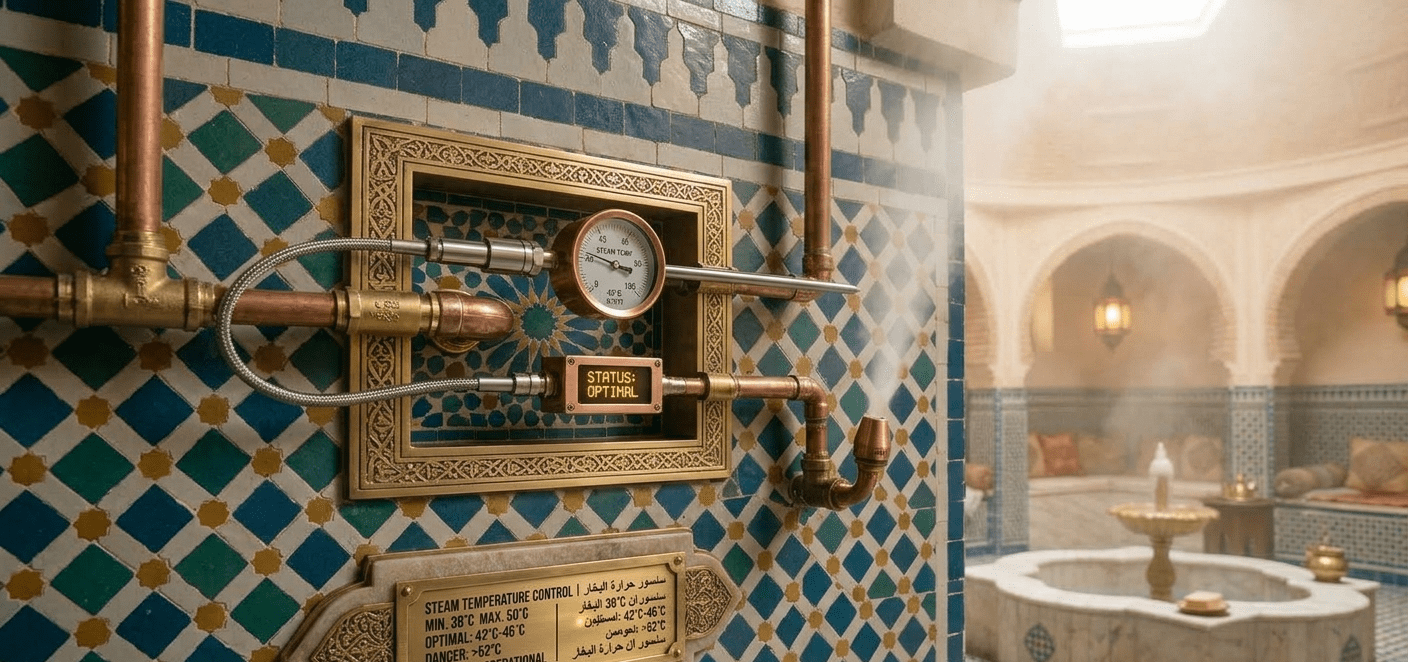
A steam generator is an electrically powered water heater that produces continuous, pressurised steam. Cold water enters the generator from the property’s mains supply, fills a stainless steel heating tank (the reservoir), and is heated by one or more electric immersion elements. When the water reaches 100°C, it converts to steam, which is pushed through a steam outlet pipe to one or more steam nozzles (injectors) positioned within the moroccan bath room. The steam fills the room, raises the air temperature to the set point (typically 43°C to 55°C for a moroccan bath room), and maintains that temperature until the thermostat signals the generator to cycle off.
Key Differences Between Moroccan Bath Room Steam Generators and Standard Steam Showers
Moroccan bath rooms are not the same environment as a standard steam shower enclosure, and the steam generator specification must reflect this:
- Room volume: a moroccan bath room is significantly larger than a standard steam shower — often 6m³ to 20m³ or more, compared to 1m³ to 3m³ for a shower cubicle. This directly affects the generator power required.
Thermal mass: moroccan bath rooms are constructed with high-density materials — thick marble slabs, tadelakt lime plaster, zellige tiles on concrete substrate. These materials absorb large quantities of heat before the room reaches operating temperature.
- The steam generator must have sufficient output to overcome this thermal mass within a reasonable heat-up time.
- Continuous vs. intermittent use: a moroccan bath room is designed for sessions of 45 minutes to 2 hours or more, compared to a steam shower session of 10 to 20 minutes. The generator must be rated for continuous duty operation, not just peak output.
- Multiple steam points: larger moroccan bath rooms may have multiple steam nozzle positions across different zones (warm room, hot room, cool area). The generator and steam distribution pipework must be designed to serve all nozzle positions adequately.
- Temperature range: the moroccan bath ritual uses a lower, more sustained temperature than a Turkish steam bath. Most moroccan bath room generators are set between 43°C and 52°C rather than the 60°C+ typical of Turkish bath installations.
How to Size a Steam Generator for a Moroccan Bath Room
Correct steam generator sizing is the single most critical decision in the entire steam system setup. An undersized generator produces inadequate steam, takes too long to reach temperature, and runs continuously at full load — shortening its service life dramatically. An oversized generator delivers too much steam, makes the room uncomfortably hot, wastes energy, and costs significantly more than necessary.
Step 1: Calculate the Net Room Volume
The starting point for steam generator sizing is the net internal volume of the moroccan bath room in cubic metres (m³). Measure the internal length, width, and height of the space and multiply them together. For rooms with non-rectangular shapes (arched ceilings, domed sections, alcoves), calculate the volume of each zone separately and add them together.
For moroccan bath rooms with traditional domed ceilings, the dome volume (approximately one-half of a sphere: 2/3 x pi x radius cubed) should be added to the rectangular room volume below. Domes create a natural heat trap that increases steam demand.
Step 2: Apply Material Adjustment Factors
The raw room volume must be adjusted upward to account for the high thermal mass of moroccan bath room construction materials. Standard steam generator sizing tables are typically based on a lightweight tile or acrylic enclosure. Moroccan bath rooms use materials with significantly higher heat absorption:
Surface Material | Volume Multiplier | Reason |
Standard ceramic tile (thin substrate) | 1.0x (baseline) | Low thermal mass |
Porcelain tile on cement board | 1.25x | Moderate thermal mass |
Natural stone (marble, travertine) | 1.5x | High thermal mass |
For most moroccan bath rooms combining zellige tiles, tadelakt walls, and a marble kessal bench, apply a multiplier of 1.5x to 1.75x to the net room volume to arrive at the adjusted volume for generator sizing purposes.
Step 3: Select Generator Power from Adjusted Volume
Adjusted Volume (m³) | Recommended Generator Power | Heat-Up Time (approx.) | Suitable For |
Up to 5m³ | 3 – 4.5 kW | 15 – 25 minutes | Small residential hammam alcove |
5 – 8m³ | 4.5 – 6 kW | 20 – 30 minutes | Standard private residential hammam |
8 – 12m³ | 6 – 9 kW | 25 – 35 minutes | Large residential or small boutique hammam |
12 – 18m³ | 9 – 12 kW | 30 – 45 minutes | Premium residential or small hotel hammam |
18 – 25m³ | 12 – 15 kW | 35 – 50 minutes | Hotel suite hammam or commercial |
25 – 40m³ | 15 – 18 kW | 40 – 60 minutes | Commercial hammam spa (single room) |
40m³+ | 18 kW+ or multiple generators | Custom design required | Multi-room commercial hammam complex |
Always size up, never down, when in doubt. A steam generator operating comfortably at 70% load will outlast one running at 95% to 100% load by many years. The cost difference between adjacent power tiers is typically small compared to the cost of early generator replacement.
Step 4: Account for UAE and Hot Climate Adjustments
For moroccan bath rooms in the UAE and other hot climates, the sizing calculation requires additional consideration. When the ambient temperature outside the moroccan bath room is already 30°C to 45°C (as in a UAE summer), less generator energy is needed to overcome heat loss through the room’s surfaces. However, the plant room or ceiling void where the generator is
typically located can reach 50°C+ in UAE summers — this affects the generator’s efficiency and the cable current ratings. UAE-based MEP engineers should apply a climate factor and confirm generator placement provides adequate cooling air to the unit’s ventilation requirements.
Types of Steam Generators for Moroccan Bath Rooms
The market for moroccan bath room steam generators offers a range of generator types from residential to heavy commercial. Understanding the key differences helps you specify the right unit for each project type:
Single-Element Residential Steam Generators
Entry-level generators with a single heating element, designed for residential moroccan bath rooms up to approximately 8m³ adjusted volume. Typically available in 3kW, 4.5kW, and 6kW ratings. These units are compact (often the size of a large briefcase), easy to install in a standard under-bench or cupboard space, and connect to a standard single-phase electrical supply. They feature a single steam outlet, an integrated thermostat, and basic digital control. Well-suited to: private villa hammams, holiday homes, and small boutique spa hammams with one or two clients per session.
Dual-Element Commercial-Grade Generators
Mid-range generators with dual heating elements, typically available from 6kW to 15kW. Dual-element units offer faster heat-up times than equivalent single-element units because both elements operate simultaneously during initial heating. They also provide a degree of redundancy — if one element fails, the other can maintain a reduced steam output until the unit is serviced. Most dual-element generators feature: digital touchscreen control panels, remote sensor capability, aromatherapy oil vessel compatibility, self-flushing drain valves for maintenance, and multiple steam outlet connections. Well-suited to: hotel suite hammams, premium residential installations, and small commercial hammam spas with moderate daily usage.
Industrial / Heavy Commercial Steam Generators
High-output generators from 15kW to 60kW or more, designed for continuous heavy-duty commercial operation in multi-room hammam spa complexes, large hotel spa facilities, resort installations, and wellness destinations. These units typically require three-phase electrical supply, dedicated plant room installation with adequate ventilation, and commercial-grade stainless steel construction throughout. They feature advanced BMS (Building Management System) integration capability, multiple steam zone control, automatic chemical dosing for scale prevention, and remote monitoring. Well-suited to: commercial hammam spa centres, five-star hotel spa facilities, resort and destination wellness spaces.
Where to Position the Steam Generator: Location and Access Requirements
The physical location of the steam generator is a critical installation decision that affects steam quality, generator longevity, maintenance access, noise levels, and electrical efficiency. The steam generator must never be installed inside the moroccan bath room itself — it must be in an adjacent, dry location.
Ideal Generator Locations
- Dedicated plant room or equipment cupboard: the best option for all moroccan bath room installations. A purpose-built or designated equipment space adjacent to the bath room provides the ideal combination of ventilation, maintenance access, and vibration isolation. Minimum recommended plant room size: 0.6m x 0.6m floor area, 0.9m ceiling height, with a service door allowing full access to all sides of the generator.
- Under-bench cabinet within a changing room or transition space: common in residential installations where a dedicated plant room is not available. The cabinet must be ventilated, accessible for maintenance, and the steam pipe run to the moroccan bath room must be kept as short as possible.
- Ceiling void above the moroccan bath room: acceptable for compact residential generators where floor space is limited, provided the void has adequate ventilation and the generator is mounted on a vibration-dampening platform with a drip tray. In UAE climates, ceiling voids must be confirmed to remain within the generator’s maximum ambient temperature rating during summer months — this frequently limits this option without supplementary cooling.
- Adjoining bathroom or utility room: a practical option where a dedicated plant space is not possible, provided the generator is properly enclosed from the bathroom’s wet zone and adequate ventilation is provided.
Maximum Steam Pipe Run Length
The steam outlet pipe connecting the generator to the moroccan bath room steam nozzle(s) must be kept as short as possible to minimise heat loss and condensation. Longer pipe runs mean more steam condenses before reaching the nozzle, reducing effective steam output and producing sluggish temperature response:
- Optimal pipe run: 1.5 metres or less — immediate adjacent location
- Acceptable pipe run: up to 4 metres with appropriate insulation
- Maximum recommended pipe run: 6 metres — beyond this, the pipe run should be insulated with high-temperature foam lagging and the generator power should be increased by one tier to compensate for line loss
- For pipe runs exceeding 6 metres, consult the generator manufacturer — some manufacturers void their warranty for excessively long uninsulated pipe runs
Ventilation Requirements for the Generator Location
Steam generators produce waste heat during operation. The generator location must have adequate ventilation to prevent heat build-up that could damage the unit or surrounding structure:
- Minimum air flow: follow the manufacturer’s specification — typically 5 to 10 air changes per hour in the generator enclosure
- For plant rooms and cupboards: provide a low-level air inlet and a high-level air outlet (louvred grille) to create natural convection — or a small mechanical ventilation fan on a thermostat
- In UAE installations: forced ventilation is typically essential given summer ambient temperatures — consider a split-unit air conditioning system in the plant room for premium commercial installations
Steam Generator Plumbing: Water Supply, Steam Outlet and Drain
The plumbing connections for a moroccan bath room steam generator involve three separate circuits: the cold water supply that fills the heating tank, the steam outlet that delivers steam to the room, and the drain that removes condensate, scale, and flush water during maintenance cycles. Each requires specific materials, pipe sizes, and installation techniques.
Cold Water Supply Connection
Pipe material: copper or stainless steel for the supply line to the generator — CPVC is acceptable in some installations but must be confirmed as suitable for continuous hot-
- side proximity. Plastic push-fit connections should not be used within 500mm of the generator body due to heat exposure.
- Supply pressure: most residential and commercial steam generators require a minimum dynamic water pressure of 1.5 bar and a maximum of 5 bar. If the property’s supply pressure exceeds 5 bar, a pressure-reducing valve (PRV) must be fitted in the supply line before the generator.
- Inlet valve: a full-bore isolating valve (ball valve or gate valve) must be fitted in the cold water supply line immediately before the generator, allowing the water supply to be isolated for maintenance without interrupting supply to the rest of the property.
- Non-return valve (check valve): a non-return valve must be fitted in the cold water supply line to prevent steam from being driven back into the mains supply during pressurised operation — required by water supply regulations in most jurisdictions.
- Supply pipe size: 15mm copper (half-inch) is typically sufficient for generators up to 9kW; 22mm copper (three-quarter inch) is recommended for generators above 9kW and for long supply line runs.
- Water softener integration: in hard water areas — including all UAE locations — fitting a dedicated water softener or scale inhibitor in the generator’s supply line dramatically reduces scale build-up in the heating tank. This is one of the most cost-effective investments in steam generator longevity, especially in Dubai and Abu Dhabi where water hardness is exceptionally high.
Steam Outlet Pipe and Nozzle Installation
- Pipe material: copper is the industry-standard material for steam outlet pipes — it withstands the temperature and pressure of the steam system, resists corrosion, and can be bent and routed through building fabric effectively. Stainless steel is used in commercial and high-specification installations. Never use plastic pipe for steam outlet pipework.
- Pipe size: 22mm copper (three-quarter inch) for generators up to 9kW; 28mm copper (one inch) for generators above 9kW. Undersizing the steam pipe creates back-pressure at the generator, reduces steam delivery, and increases wear on the generator’s internal components.
- Pipe insulation: the steam outlet pipe must be insulated with high-temperature foam or mineral wool pipe lagging to minimise heat loss and condensation between the generator and the nozzle. In UAE installations where pipe runs may pass through hot ceiling voids, insulation is critical.
- Gradient: the steam pipe must slope continuously downward from the generator to the nozzle — a minimum fall of 10mm per metre — to allow condensate to drain toward the room rather than back to the generator. Condensate collecting at a low point in an incorrectly graded pipe causes water hammer (banging) and can damage the generator.
- Steam nozzle (injector) position: the steam nozzle should be positioned 200mm to 300mm above the floor level on one of the side walls of the moroccan bath room, pointing slightly downward toward the floor. Floor-level positioning allows the steam to rise naturally and fill the room evenly. Never position the nozzle near the entrance door or behind the kessal bench where users will be sitting — directing steam onto the body from close range can cause burns.
- Multiple nozzle installations: for larger moroccan bath rooms, two or more nozzle positions can be connected to a single generator using a steam distribution manifold. The manifold allows balanced steam delivery to each nozzle and includes individual isolation valves for maintenance. The generator must be sized to supply the combined demand of all nozzle positions.
Condensate and Drain Connection
- Drain pipe material: copper or PVC (above 80°C rated) for the condensate drain — regular cold water waste pipe is not suitable for the high-temperature condensate produced during generator operation and flush cycles.
- Drain connection: the generator’s drain outlet must connect to a properly vented waste pipe with a trap, discharging to the property’s drainage system. The drain must be large enough to handle the full flush volume of the generator tank — most manufacturers specify a 32mm (1.25 inch) or 40mm (1.5 inch) drain connection.
- Auto-drain and self-flushing: most commercial and many residential steam generators include an automatic drain valve that opens at the end of each session (or on a timed cycle) to flush the heating tank of scale and mineral deposits. This auto-drain facility is one of the most important features for longevity in hard water areas — ensure it is connected and functioning correctly as part of the commissioning process.
- Safety relief valve: a pressure relief valve (set at the generator manufacturer’s specified pressure, typically 0.5 to 1.0 bar above operating pressure) must be fitted to the steam outlet and piped to a safe discharge point — not into the moroccan bath room itself.
Heat-up time depends on the generator’s power rating relative to the room volume and the thermal mass of the moroccan bath room’s materials. A correctly sized generator should reach the set operating temperature (typically 45°C to 50°C for a moroccan bath room) in 20 to 45 minutes. Rooms with very high thermal mass (solid marble walls and floor, thick tadelakt, large kessal bench) will take longer on first heat-up. If your generator is consistently taking longer than 45 minutes to reach temperature, it may be undersized — recalculate using the material multiplier factors for moroccan bath room construction.
Yes, absolutely. The steam generator must always be on its own dedicated electrical circuit, protected by its own ELCB/RCD breaker. Sharing a generator circuit with other loads causes voltage drop under full generator load (which reduces steam output and can trigger the generator’s protection systems), makes fault finding more complicated, and prevents the generator from being isolated independently for maintenance. The circuit must also be protected by a 30mA residual current device — this is mandatory under wiring regulations, UAE electrical codes (DEWA, ADDC, SEWA), and most other jurisdictions’ electrical standards.