Moroccan Hammam Interior Design: Tiles, Lighting, and Materials
Step inside any great Moroccan hammam and you experience something that transcends ordinary interior design. The geometry of the zellige tiles, the warm luminosity of the tadelakt walls, the intricate filigree of carved gypsum, the amber glow of lantern lighting, and the scent of argan oil and rose water combine into a sensory world that feels simultaneously ancient and supremely contemporary. This is the power of authentic moroccan interior design — and it is exactly why architects, interior designers, hotel developers, and homeowners across Dubai, London, New York, and beyond are commissioning Moroccan hammam interiors for the world’s most ambitious luxury projects.
But creating a hammam interior that achieves genuine authenticity — rather than a superficial impression of it — requires deep knowledge of the materials, traditions, proportions, and craft techniques that define the Moroccan aesthetic. Moroccan interior design for hammams is not a style that can be achieved by painting walls a warm ochre and adding a few decorative tiles. It is an integrated system of materials, spatial logic, light, colour, pattern, and craftsmanship that must work together as a whole.
This comprehensive guide covers every element of moroccan interior design for hammam spaces — from the foundational materials (zellige, tadelakt, marble, gypsum, cedar) through to colour palettes, tile pattern systems, lighting design, archway and dome construction, furniture and accessories, and the specific design considerations for UAE climates. Whether you are designing your first hammam or your twentieth, this is the reference you will return to.
The Philosophy Behind Authentic Moroccan Interior Design
Before selecting a single tile or specifying a paint colour, it is essential to understand the philosophical and cultural principles that give authentic moroccan interior design its distinctive character. These are not aesthetic preferences — they are functional and spiritual principles that have shaped the design language of Moroccan architecture for over a thousand years.
The Geometry of the Divine
The geometric patterns that dominate moroccan interior design — the star polygons, interlocking hexagons, and fractal zellij mosaics — are not merely decorative. They derive from Islamic geometric art, which understands complex mathematical patterns as a reflection of divine order and infinity. The eight-pointed star (khatim), the twelve-pointed star, the six-pointed rosette, and the complex muqarnas vaulting that fills Moroccan domes all emerge from the same geometric principle: infinite complexity from simple rules. Understanding this is essential for authentic hammam design, because authentic moroccan interior design does not use random pattern combinations — each pattern system has rules, proportions, and appropriate contexts.
The Horizontal Division of Space
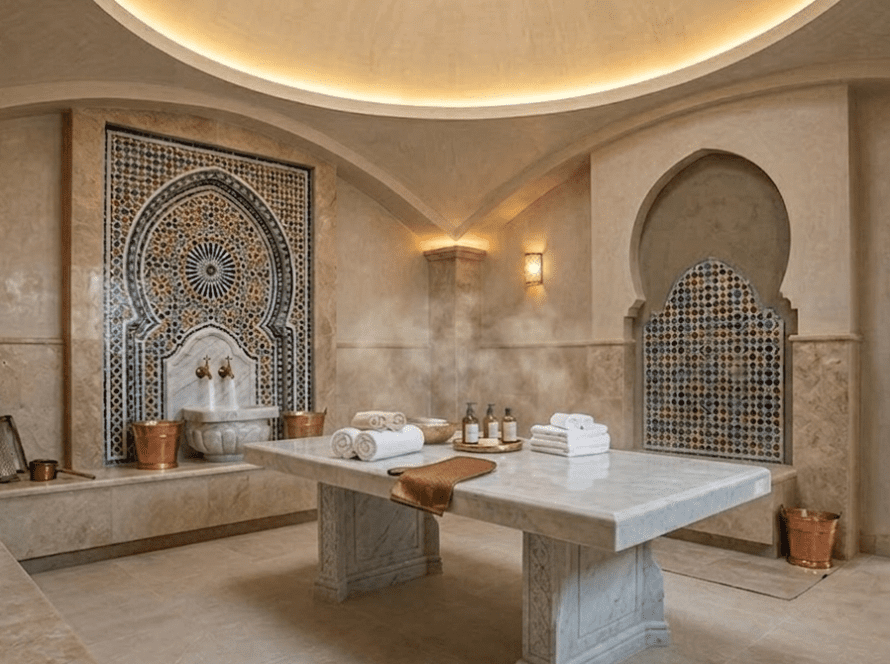
One of the most distinctive features of authentic moroccan interior design is the horizontal division of the wall into three distinct zones. The lower third is typically covered in zellige tilework, providing water resistance and geometric visual complexity at eye level when seated. The middle zone is often finished in tadelakt lime plaster, creating a smooth, luminous surface that transitions from the patterned lower zone to the upper architecture. The upper third and ceiling feature carved plaster (jbss), carved cedar wood, or painted and gilded decoration reaching toward the dome or ceiling. This tripartite vertical organisation is the structural grammar of moroccan interior design and should be respected in any authentic hammam interior.
The Interplay of Light and Shadow
Moroccan interior design has always understood light as a material — something to be shaped, filtered, and deployed as deliberately as any physical element. Traditional riads and hammams are designed to create moving patterns of light and shadow throughout the day, using star-pierced plasterwork, carved wooden screens (mashrabiyya), and the strategic placement of lanterns and windows. In a hammam interior, this translates to a lighting design that produces warm, low-level ambient light punctuated by the sparkle of fibre optic stars, the flicker of metalwork lanterns, and the diffuse glow of backlit onyx or alabaster panels.
The Primacy of Natural Materials
Authentic moroccan interior design uses natural, locally sourced, and largely untreated materials wherever possible. Lime plaster, clay, natural pigments, hand-cut terracotta, marble, cedar wood, and raw iron are the fundamental material vocabulary. Synthetic imitations — ceramic tiles printed to resemble zellige, polyurethane foam sold as plaster moulding, vinyl flooring with a stone print — are immediately recognisable as inauthentic to anyone who has experienced the real thing. The texture, weight, imperfection, and warmth of genuine materials are intrinsic to the experience of moroccan interior design.
Zellige Tiles: The Centrepiece of Moroccan Interior Design
Of all the elements that define moroccan interior design, zellige is arguably the most iconic and the most demanding to execute well. Zellige (also spelled zellij) tiles are hand-cut, hand-glazed pieces of terracotta, assembled into complex geometric mosaics that cover the lower walls, floors, fountains, and often the entire surfaces of hammam interiors. They are made today in Fez, Morocco — largely by the same artisan cooperatives that have produced them for centuries — using techniques virtually unchanged since the mediaeval period.
How Zellige Is Made
The production of authentic zellige begins with fired terracotta tiles, glazed in one of Morocco’s traditional colour families (cobalt blue, turquoise, white, black, ochre yellow, tomato red, sage green, ivory, and charcoal). The glaze is applied by hand, fired a second time in a wood-burning kiln, and then — critically — the individual tesserae (the shaped pieces that make up the mosaic) are cut by hand using a small hand axe called a menou. The skill of the zellige cutter determines the precision of the final mosaic. The slight imperfection in shape, the variation in glaze depth, and the irregular surface texture that results from hand-cutting are not flaws in zellige — they are the signature of authenticity. Machine-cut ceramic tiles may achieve greater
dimensional precision, but they entirely lack the visual richness that makes zellige the supreme tile art form of the Islamic world.
Traditional Zellige Pattern Systems for Hammam Interiors
Authentic moroccan interior design uses a defined vocabulary of geometric pattern systems for zellige mosaics. The most important for hammam interiors are:
- Hasba (eight-pointed star): the most widely used zellige pattern in moroccan interior design, built from eight-pointed stars connected by cross shapes. Infinitely scalable and suitable for both floor and wall applications.
- Khatim (seal of Solomon): based on a six-pointed star with triangular interstices. Associated with wisdom and spiritual protection — historically used in mosques and significant private spaces.
- Fes el-Bali (complex twelve-pointed star): a more elaborate pattern requiring greater cutter skill, associated with the finest Fez workshops. Used in premium hammam interiors and royal guest spaces.
- Sabaa (seven-pointed star): an unusual pattern based on seven-fold symmetry — mathematically complex and visually arresting. A mark of extraordinary craftsmanship when executed well.
- Checkerboard (Marrakchi square): a simple but highly effective alternating pattern using two contrasting glaze colours. Often used on hammam floors where complex patterns may be overwhelming or slippery.
- Brickwork and running bond variants: horizontal or offset rectangular zellige layouts, often used as border patterns or transitional zones between more complex field patterns.
Colour Palettes in Zellige for Moroccan Hammam Interiors
Colour Family | Traditional Name | Glaze Tone | Typical Hammam Application |
Cobalt blue | Azul (Arabic) | Deep sapphire to electric blue | Lower wall field tiles, border highlights, fountain basins |
Turquoise | Zarka faransiya | Bright aquamarine to soft cyan | Large field patterns, transition zones, ceiling accents |
White / Ivory | Biyed | Pure white to warm cream | Star infill, contrast elements, border separation lines |
Black / Charcoal | Khal | Matte charcoal to glossy black | Geometric outlines, definition lines, floor patterns |
Ochre Yellow | Sfar / Ldahbi | Golden yellow to deep mustard | Accent stars, border accents, kessal bench surround |
Tomato Red | Hamra | Terracotta to deep red | Traditional floor patterns, transition strips, accent elements |
Sage Green | Khdra | Soft sage to forest green | Nature-inspired palettes, relaxation zones, outdoor-adjacent hammams |
Ivory / Pale Buff | Bej | Warm off-white to pale sand | Neutral field tiles for lighter, more contemporary interpretations |
Sourcing Authentic Zellige for International Projects
For hammam projects outside Morocco — including Dubai, London, Paris, and New York — sourcing authentic zellige requires working either directly with Fez-based artisan cooperatives or through specialist distributors who source directly from Morocco and can provide provenance documentation. Key considerations for international zellige sourcing:
- Lead time: authentic zellige is made to order and typically requires 8 to 16 weeks from order to delivery — allow for this in the project programme from day one
- MOQ (Minimum Order Quantity): most Fez cooperatives have minimum order quantities of 30 to 50 square metres — suitable for most hammam projects
- Custom colour matching: experienced cooperatives can match specific colour references (RAL, Pantone) within the natural glaze range, allowing integration with broader interior schemes
- Sample approval: always approve physical tile samples before placing a full order — glaze colours can vary between production batches and should be confirmed against the project’s actual lighting conditions
- Import documentation: for UAE projects, ensure zellige tiles are imported with appropriate customs documentation and certificates of origin — required for heritage certification and some luxury hotel brand approval processes
In UAE moroccan interior design projects, zellige tiles should be sourced before the project’s structural waterproofing is completed — the adhesive system used to fix zellige must be compatible with the waterproofing membrane. Specify this in the material and installation coordination schedule from the project outset.
Tadelakt: The Living Surface of Moroccan Interior Design
If zellige provides the geometric soul of moroccan interior design, tadelakt provides its warmth and luminosity. Tadelakt is a traditional Moroccan wall finish made from lime plaster (slaked lime, fine marble sand, and natural pigments), applied in multiple thin coats, burnished to a smooth sheen using polished stones, and then treated with savon noir (Moroccan black soap) during curing. The chemical reaction between the lime and the soap creates calcium stearate — a naturally hydrophobic compound that seals the surface, making it water-resistant without any synthetic sealant.
The Visual Character of Tadelakt
Authentic tadelakt has a distinctive visual quality that no commercial imitation has successfully replicated: a satin sheen that moves and changes with the light, subtle colour variations caused by the hand application process, slight surface texture that reveals the movement of the plasterer’s trowel, and a warmth of tone that comes from natural mineral pigments rather than synthetic dyes. In a hammam interior, tadelakt walls create the feeling of being inside a living
material — warm, organic, and deeply sensory. This is precisely what makes tadelakt central to authentic moroccan interior design.
Traditional Tadelakt Colours for Hammam Interiors
Tadelakt is available in any colour achievable within the natural mineral pigment range. For moroccan interior design, the most authentic and widely used colours in hammam applications are:
- Warm ochre and saffron: the most classically Moroccan tones — the warm golden-yellow of saffron and the deeper amber-ochre of Marrakech’s medina walls. These colours create an instantly recognisable moroccan warmth and are particularly effective in lower-light hammam environments.
- Terracotta and adobe: earthy red-brown tones that evoke the clay architecture of southern Morocco and the Saharan ksour. Particularly effective in hammam rooms designed with a more ancient, elemental aesthetic.
- Warm white and bone: a lighter alternative that maximises the reflectivity of the hammam space while retaining the organic warmth of the lime plaster. Popular in contemporary moroccan interior design where a cleaner, more minimalist palette is desired.
- Sage and olive: soft green tones that reference Morocco’s olive groves and cedar forests. Used in hammams designed to evoke the natural landscape rather than the urban medina.
- Charcoal and slate: dramatic dark tones that create a sense of deep immersion and mystery. Used in premium private hammam suites where theatrical impact is a design priority.
- Rose and blush: softer, more contemporary interpretations of traditional Moroccan pigment tones. Increasingly popular in luxury hotel moroccan interior design, particularly in women’s hammam suites.
Tadelakt Application Zones in a Hammam
Not every surface in a hammam should be tadelakt. Authentic moroccan interior design uses tadelakt strategically, in combination with zellige and other materials:
- Upper walls (above the zellige border): the primary tadelakt zone in most hammam interiors. The transition from geometric zellige below to smooth tadelakt above is one of the most distinctive features of authentic moroccan interior design.
- Ceilings and dome interiors: tadelakt is ideally suited to ceiling surfaces in steam-rich hammam environments. Its seamless, grout-free nature eliminates the mould and mineral deposit problems common with grouted tile ceilings.
- Steam room alcoves and niches: small architectural features such as soap niches, towel alcoves, and decorative recesses are ideal tadelakt applications — the material’s ability to form seamless curved surfaces makes it far superior to tile in these positions.
- Kessal bench tops and integrated basins: tadelakt is widely used for the surfaces of heated marble-alternative benches and hammam basins in both residential and commercial applications.
Avoid tadelakt on floors (for most hammam installations): while tadelakt is technically possible on floors, it is prone to staining and discolouration from standing water, foottraffic, and the scrubbing involved in hammam use. Zellige, natural stone, or micro-cement are more appropriate floor materials in most hammam settings
Natural Stone, Marble and the Kessal Bench in Moroccan Interior Design
Natural stone is the third foundational material of moroccan interior design for hammam spaces. It provides weight, permanence, and a quality of sensory richness that synthetic alternatives cannot approach. In an authentic hammam, stone appears in floors, water basins, kessal benches, column bases, door surrounds, and fountain surfaces.
The Kessal Bench (Heated Marble Slab)
The kessal bench — the central heated marble slab that occupies the heart of the main hammam chamber — is the single most important piece of furniture in moroccan interior design for hammam spaces. Traditionally, the kessal is a solid block of marble or stone, heated from below by the hammam’s heating system (historically a wood fire; today typically an electric underfloor heating mat or hydronic system). Users lie on the warm marble surface during the ghassoul clay treatment and relaxation phases of the ritual.
For contemporary moroccan interior design, the kessal bench specification involves:
- Material: white Carrara marble, Calacatta, Portuguese marble, or Atlas Mountains marble are the most frequently specified materials. For UAE projects, local quarried marble from Jordan or the broader Arab world creates a material provenance narrative that resonates with the region’s heritage.
- Size: a single-person kessal typically measures 600mm x 1800mm — large enough for an adult to lie fully extended. Commercial hammam kessal benches in hotel or spa settings are often 1200mm x 2000mm or larger.
- Finish: honed (matte polished) marble is preferred over glossy polished for hammam kessal benches — the matte surface is less slippery when wet and shows water less visibly.
- Height: the traditional kessal height is approximately 600mm to 700mm — at the upper end of standard bench height to facilitate easy access for the hammam therapist performing the massage and scrub treatments.
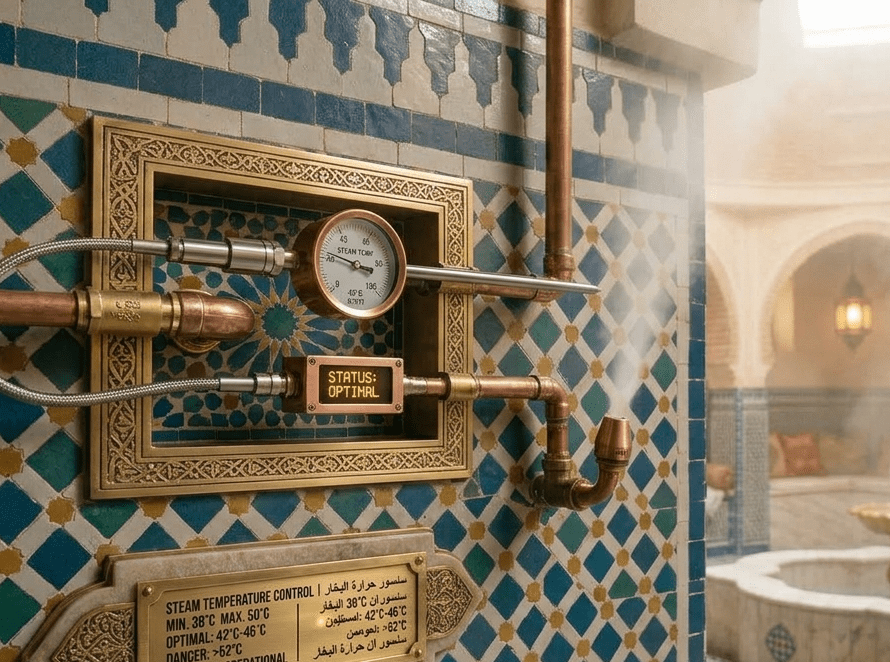
- Heating: the underfloor heating element beneath the kessal is typically electric for residential applications, with a target surface temperature of 38°C to 42°C — warm to the touch but not uncomfortably hot.
Floor Stone for Moroccan Hammam Interiors
- Marble: the most prestigious flooring choice for moroccan interior design. White, cream, or pale grey marble with natural veining creates an instantly luxurious floor surface. Anti-slip treatment or honing to a fine matt finish is essential for safety in a wet hammam environment.
- Travertine: a warm, organic alternative to marble with a slightly more textured surface that provides natural slip resistance. Beige, walnut, and ivory travertine are particularly well-suited to the earth-toned palettes common in moroccan interior design.
- Limestone: softer than marble and more susceptible to acid etching from hammam products (particularly lime-based tadelakt runoff), but beautiful in appearance. Specify a densified or sealed limestone for floor use in hammam environments.
- Moroccan terracotta (bejmat): unglazed hand-formed terracotta tiles, slightly irregular in shape and thickness, that create a deeply authentic moroccan floor surface. Less formal than marble, more contextually Moroccan, and excellent underfoot texture for hammam use.
- Zellige on floors: the same zellige tiles used on walls can be applied to hammam floors, typically using simpler patterns with better slip resistance. Specify a matt or semi-matt glaze rather than a high-gloss finish for floor zellige.
Carved Gypsum, Cedar Wood and the Upper Architecture
In the tripartite vertical organisation of moroccan interior design, the upper zone — above the tadelakt walls — is where the most elaborate and structurally complex decoration appears. Two materials dominate this zone: carved gypsum plaster (jbss in Moroccan Arabic, or stucco plaster) and carved or painted cedar wood (cedar being the primary structural and decorative timber of Moroccan architecture).
Carved Gypsum Plaster (Jbss / Plâtre)
Carved gypsum plaster is the material of Moroccan domes, arched ceilings, decorative friezes, and the exquisite perforated screens that filter light in traditional riads and hammams. It is applied wet and carved by hand while still in a semi-soft state — a skill that takes years to master and produces results of extraordinary delicacy and geometric precision. In a hammam interior, carved gypsum plaster appears in:
- Dome interiors: the interior of a hammam dome is frequently covered in muqarnas — a three-dimensional honeycomb of carved plaster cells that transforms the transition from wall to dome into a spectacular three-dimensional geometric composition. The play of light and shadow within muqarnas is one of the most powerful effects in moroccan interior design.
- Decorative friezes and borders: carved plaster friezes at the transition between the tadelakt zone and the upper architectural zone provide a horizontal emphasis that reinforces the traditional tripartite wall division.
- Arched door surrounds and window frames: elaborately carved plaster surrounds for arched openings are one of the most recognisable visual signatures of moroccan interior design. In a hammam, the main entrance arch is a natural location for a decorative carved plaster surround.
- Perforated plaster screens (mashrabiyya in plaster): these screens allow light to pass through complex geometric patterns while maintaining visual privacy. In a hammam context, they can be used between zones or above transition doorways to filter light beautifully.
Cedar Wood Ceilings and Doors
Atlas cedar (Cedrus atlantica) is the iconic timber of Moroccan architecture. In traditional moroccan interior design, cedar wood appears in:
- Coffered cedar ceilings: a grid of carved and painted cedar beams forming a coffered ceiling pattern, typically painted in polychrome (blue, green, red, and gold on a natural cedar ground). These ceilings are among the most spectacular elements of moroccan interior design and are particularly effective in the relaxation area adjacent to the hammam.
- Cedar carved doors: arched double doors with carved geometric or floral panel decoration are the signature entrance feature of traditional Moroccan spaces. In a contemporary hammam interior, solid cedar doors with traditional carving provide an instant visual signal of authentic moroccan interior design.
- Turned cedar screens (moucharabieh): decorative screens of turned cedar dowels in complex geometric arrangements, used as room dividers or window treatments in traditional moroccan interior design. In modern hammam interiors, these are often backlit to create dramatic decorative effects.
In UAE moroccan interior design projects, Atlas cedar from Morocco must be imported — it is not locally sourced. Ensure cedar is kiln-dried to appropriate moisture content for the UAE’s air-conditioned indoor environment before installation, and treat with appropriate preservative to protect against the dry conditions that can cause cedar to split over time in heavily air-conditioned spaces.
Lighting Design in Moroccan Hammam Interiors
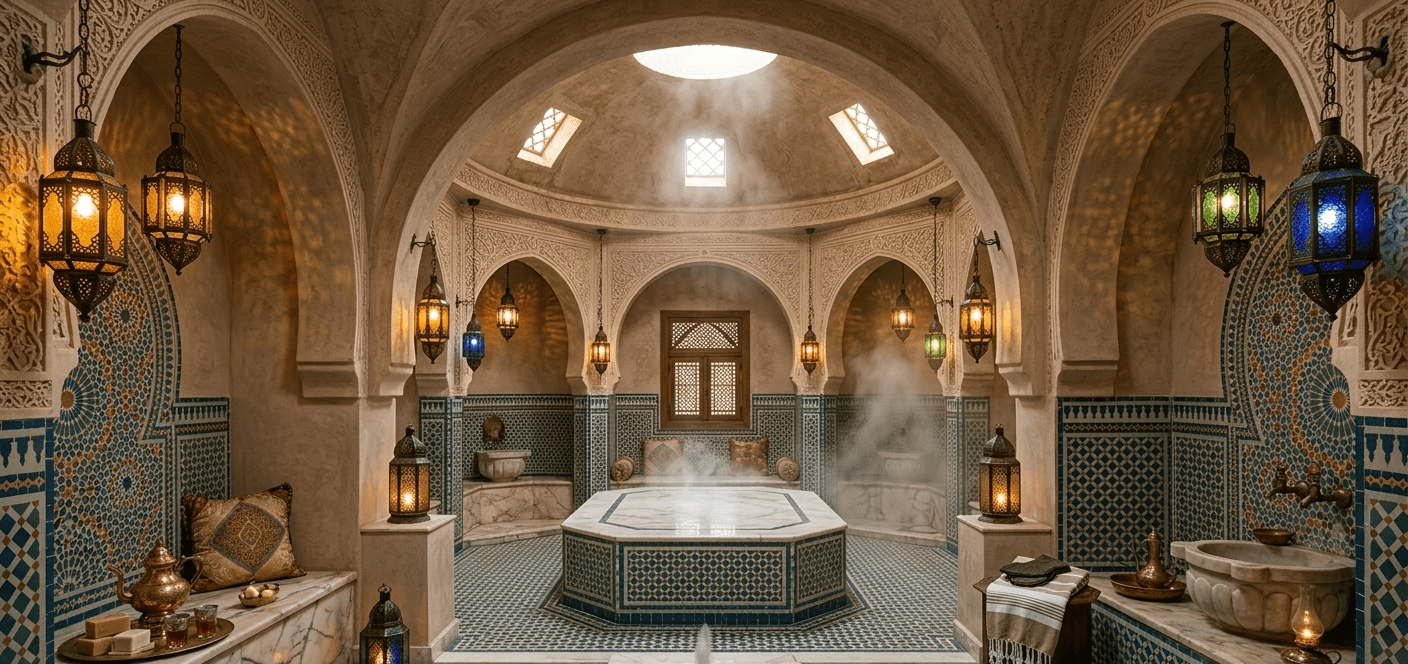
Lighting is arguably the most transformative element of moroccan interior design for hammam spaces. The traditional Moroccan hammam was lit by a single circular or star-shaped opening in the dome, allowing a single shaft of diffuse natural light to fall into the steam-filled room — an image so powerful it has inspired architects and designers for centuries. Contemporary moroccan interior design reinterprets this luminous tradition using a combination of fibre optic technology, metalwork lanterns, backlit translucent stone, and carefully positioned LED systems to create lighting that is simultaneously functional and deeply atmospheric.
The Fibre Optic Star Ceiling
The star ceiling created by fibre optic points in a dark tadelakt or painted ceiling surface is one of the most popular and most effective lighting effects in contemporary moroccan interior design. When executed well, it creates the impression of being bathed in starlight — perfectly aligned with the traditional Moroccan hammam’s spiritual connection to the cosmos. Key design considerations:
- Varying fibre diameters: use a mix of 0.5mm, 0.75mm, and 1.0mm fibre diameters to create variation in star size and apparent distance — mimicking the actual distribution of stars in the night sky.
Twinkle effect: specify an illuminator with a built-in twinkle wheel or colour wheel — producing a subtle, irregular variation in point brightness that creates the impression of stars twinkling in atmospheric condition Fibre density: for a realistic night-sky effect, a minimum of 150 to 300 fibre points per square metre of ceiling is recommended. Higher density creates a denser, more brilliant effect.
- Colour temperature: warm white (2700K to 3000K) fibre optic illuminators create the warmest, most romantic effect. Colour-changing illuminators allow the ceiling to transition through warm gold, deep blue, and violet tones — a particularly spectacular effect in a private hammam suite.
- Illuminator location: the fibre optic illuminator must be located outside the hammam in a ventilated, dry space — a ceiling void, plant room, or service cupboard. In UAE installations, the illuminator space must remain within the unit’s ambient temperature specification during summer.
Traditional Moroccan Lanterns (Fanous)
The perforated metalwork lantern — the fanous — is one of the most immediately recognisable signatures of moroccan interior design. In a hammam interior, lanterns serve both as functional light sources and as the primary decorative metalwork element. Authentic Moroccan lanterns are made from brass, copper, or wrought iron, pierced with geometric or floral patterns that project intricate shadow grids onto surrounding surfaces when lit. Design guidance:
- Scale: larger lanterns — 400mm to 800mm in diameter — make a stronger visual statement and project larger shadow patterns. Cluster smaller lanterns (200mm to 300mm diameter) in groups of three or five to create similar visual impact.
- Height: hanging lanterns in the relaxation or transition space should hang at approximately 1.8m to 2.0m above finished floor level — low enough to be experienced intimately, but high enough not to obstruct movement.
- IP rating: lanterns positioned inside the steam room must be adapted for wet-area use with IP65-minimum ratings and appropriate LED light sources. Traditional metalwork lanterns used in the steam environment should have all electrical components removed and replaced with IP-rated LED equivalents.
- Finishes: aged brass, burnished copper, and blackened wrought iron are the most authentic moroccan interior design finishes for lanterns. Avoid chrome or brushed nickel — these materials are entirely outside the moroccan design vocabulary.
Backlit Onyx and Alabaster Panels
One of the most luxurious effects available in moroccan interior design is the use of backlit translucent stone panels — typically onyx or alabaster — mounted over an LED light source. When lit from behind, these panels glow with a warm amber or honey light that transforms a wall surface into something approaching a living element. Onyx from Morocco’s Atlas Mountains and from Iran is particularly prized for its warm golden and terracotta tones, which align perfectly with traditional moroccan interior design palettes. Applications in hammam interiors:
- Feature wall panel behind the kessal bench
- Niche and alcove back panels
- Bathroom vanity counter or basin surround in the changing area
- Decorative panel in the relaxation zone opposite the hammam entrance
Ambient LED Wash Lighting
Beyond the decorative centrepieces, a base layer of warm ambient LED lighting provides the functional illumination that allows safe use of the hammam. All LED fittings within the steam room must meet IP65 minimum (IP67 for floor level) and must be rated for the actual ambient
temperature of the steam environment. For moroccan interior design, the key is keeping this functional lighting invisible as a hardware element — recessed fittings, cove lighting, and under-bench LED strips that illuminate surfaces without the fitting itself becoming visible are all appropriate approaches.
Arches, Domes and the Spatial Architecture of Moroccan Interior Design
The arch and the dome are the structural and aesthetic symbols of Islamic architecture — and therefore of moroccan interior design at its most powerful. In a hammam interior, the arch defines doorways, transitions, and niches; the dome crowns the principal bathing chamber and creates the defining spatial experience of the authentic Moroccan hammam.
The Horseshoe Arch (Arch Arabe)
The classic arch form of Moroccan and Andalusian architecture is the horseshoe arch — an arch that extends beyond the semicircle to create a rounded form that is wider at its base than a true semicircle. In moroccan interior design, the horseshoe arch appears at doorways, niches, window openings, and decorative recesses throughout the hammam interior. Its proportions convey both elegance and a distinctively Moroccan spatial identity. Modern construction uses reinforced concrete, steel, or timber falsework to form the arch during construction — traditional moroccan interior design would have used brick or stone voussoirs (wedge-shaped arch units).
The Muqarnas (Honeycomb Vaulting)
Muqarnas are the three-dimensional stalactite-like vaulted structures that appear in transitions from square wall to circular dome — the squinch zone — and as decorative vault infill in niches and doorway hoods. They are created from individual carved plaster cells, each contributing to an overall geometric system that produces a dramatically three-dimensional surface. In moroccan interior design, muqarnas are the supreme expression of geometric craft — they create a surface that appears both architecturally structural and impossibly delicate simultaneously. For hammam projects, muqarnas are typically specified in the dome squinch zone and above major doorways.
The Hammam Dome
The characteristic dome of the traditional hammam — pierced with circular or star-shaped oculi that admit shafts of diffuse natural light — is one of the most beautiful elements of moroccan interior design and one of the most challenging to construct in a contemporary building context. For new-build hammam installations, the dome is typically constructed using one of three methods:
Furniture, Accessories and Finishing Details in Moroccan Hammam Interiors
The finest moroccan interior design is defined not just by its major material surfaces but by the intelligence and authenticity of its finishing details — the hardware, the textiles, the ceramic accessories, and the small design decisions that reward careful attention.
Moroccan Metalwork and Hardware
- Door furniture: hand-forged iron or cast brass door handles, hinges, and knockers in traditional Moroccan profiles are essential to authentic moroccan interior design. Avoid standardised architectural hardware — the specificity of Moroccan metalwork forms is a key part of the design language.
- Water basins and taps: handmade hammered brass or copper taps and basins — in the traditional Moroccan style with a single-piece spout — are the most authentic choice. Contemporary versions that incorporate thermostatic control within a traditional brass body are widely available from specialist Moroccan hardware suppliers.
- Towel hooks and rings: forged iron or bronze hooks in traditional Moroccan profiles mounted on a zellige or tadelakt wall surface create an immediate visual shorthand for authentic moroccan interior design in any bathroom or changing area.
Moroccan Textiles
- Hammam towels: traditional fouta hammam towels — flat-woven in cotton or cotton-linen blend, with a simple stripe or small woven geometric border — are the authentic Moroccan hammam textile. They are lighter and faster-drying than standard terry cloth towels, absorb moisture more effectively when draped on warm skin, and they look beautiful folded on a marble shelf.
- Kilim cushions and floor seating: in the relaxation area adjacent to the hammam, floor seating covered in traditional Moroccan kilim fabric creates an authentic resting environment that extends the moroccan interior design language into the post-bathing rest space.
- Pouf (Moroccan leather footstool): hand-stitched Moroccan leather pouf in traditional arabesque stitch patterns are a classic accessory of moroccan interior design — practical as footstools and visually rich in texture and colour.
Ceramic Accessories
- Beldi soap dishes: hand-painted Moroccan pottery from Safi or Fez — in blue and white, or in bold polychrome — for soap, argan oil, and ghassoul presentation are the authentic accessory choice for a hammam shelf or niche.
10 Common Moroccan Interior Design Mistakes in Hammam Projects
Even experienced interior designers sometimes make errors in moroccan interior design for hammam projects. These are the ten most common mistakes — and how to avoid them:
- Using machine-cut ceramic tiles labelled as ‘Moroccan style’ instead of authentic hand-cut zellige — the difference is immediately visible and defeats the purpose of investing in a moroccan interior design project
- Mixing inconsistent pattern scales — zellige patterns have established proportional rules; mixing a large-scale star field with a small-scale border from a different geometric family creates visual incoherence
- Applying high-gloss tadelakt using synthetic sealers instead of traditional savon noir curing — the result looks plastic rather than organic and the surface lacks the characteristic tadelakt warmth
- Using cool white (4000K+) LED lighting in a space with warm-toned zellige and tadelakt — this destroys the warmth of the colour palette and makes the space feel clinical rather than atmospheric
- Neglecting the vertical tripartite division — placing zellige from floor to ceiling with no tadelakt zone removes the essential spatial grammar of moroccan interior design
- Choosing an oversized geometric pattern for a small space — scale matters enormously in zellige design; a large-scale twelve-pointed star pattern requires a wall height of at least 2.4m to complete its repeat and read as intended
- Using mass-market Moroccan-style lanterns made from thin zinc alloy instead of genuine hand-crafted brass or iron lanterns — the quality difference is visible and palpable
- Omitting the carved plaster or cedar upper zone — without this element, moroccan interior design reads as incomplete; the upper zone provides the vertical conclusion of the design composition
- Installing the kessal bench too low — a kessal at standard bench height (450mm) is difficult to use for hammam therapy; the correct height is 600mm to 700mm
Failing to coordinate the zellige pattern with the room’s architectural geometry — the starting point of the zellige pattern should always align with a centreline of the space; off-centre or randomly started patterns immediately signal a lack of design intention
A complete moroccan interior design fit-out for a residential hammam in Dubai typically takes 10 to 18 weeks from design sign-off to completion. The timeline includes: zellige tile ordering and importation from Morocco (8 to 12 weeks lead time), waterproofing and substrate preparation (1 to 2 weeks), zellige tile installation (1 to 3 weeks depending on room size and pattern complexity), tadelakt application and curing (1 to 2 weeks — the multi-layer process cannot be rushed), carved plaster installation (1 to 2 weeks), lighting and electrical installation (1 week), and snagging and completion (1 week). Commercial hotel moroccan interior design projects typically take 16 to 30 weeks for the full scope.
The cost of moroccan interior design and fit-out for a hammam in Dubai varies significantly with quality level and scope. As a broad indication for 2026: a high-quality residential hammam interior fit-out (zellige, tadelakt, marble kessal bench, atmospheric lighting, carved plaster arch) typically costs between AED 120,000 and AED 450,000 for a standard-sized room (6 to 12 square metres). Premium and bespoke hotel-quality moroccan interior design schemes for larger installations can reach AED 600,000 to AED 2 million or more. Material costs alone — particularly for authentic imported zellige and hand-carved plaster — represent a significant portion of the total. Always obtain itemised quotations from specialist moroccan interior design contractors.
Zellige is made from hand-glazed, kiln-fired terracotta that is individually cut by hand using a small axe (menou) by trained artisans in Fez, Morocco. Regular mosaic tiles are machine-cut from ceramic, glass, or porcelain to uniform dimensions and tolerances. The key visual differences are: zellige has a slightly irregular surface texture and varying glaze depth that creates depth and visual richness under light — characteristics that machine-cut tiles cannot replicate. Zellige pieces also vary slightly in shape and size, creating a natural slight unevenness in the finished surface that is a hallmark of authentic moroccan interior design. Mass-market ceramic tiles described as ‘Moroccan style’ or ‘zellige-inspired’ are not the same product and do not deliver the same result.
Conclusion: Moroccan Interior Design as a Living Art Form
Authentic moroccan interior design for hammam spaces is one of the great achievements of human craft tradition. It draws on over a thousand years of accumulated knowledge — geometric mathematics encoded in hand-cut tile, mineralogy expressed in the chemistry of lime plaster, woodworking mastery manifested in cedar carving, metallurgy realised in lanterns that have illuminated medinas since the mediaeval period. When you commission a hammam interior in the authentic moroccan tradition, you are not simply choosing a decorative style. You are commissioning a living connection to that tradition.
The zellige artisan in Fez who cuts your tiles by hand, the tadelakt plasterer who burnishes your walls with polished stones, the gypsum carver who traces geometric patterns into soft plaster with a practised hand — these are the inheritors of a craft lineage that stretches back centuries. Their work, placed in your hammam in Dubai, London, or New York, carries that lineage forward into the present. That is the authentic meaning of moroccan interior design. And it is why, when it is done well, it creates spaces that no other interior tradition can match.
Invest in the real materials. Find the genuine craftspeople. Understand the design grammar before you begin. And then let one of the world’s greatest interior traditions speak for itself.