The Complete Installation Guide for a Moroccan Hammam materials UAE
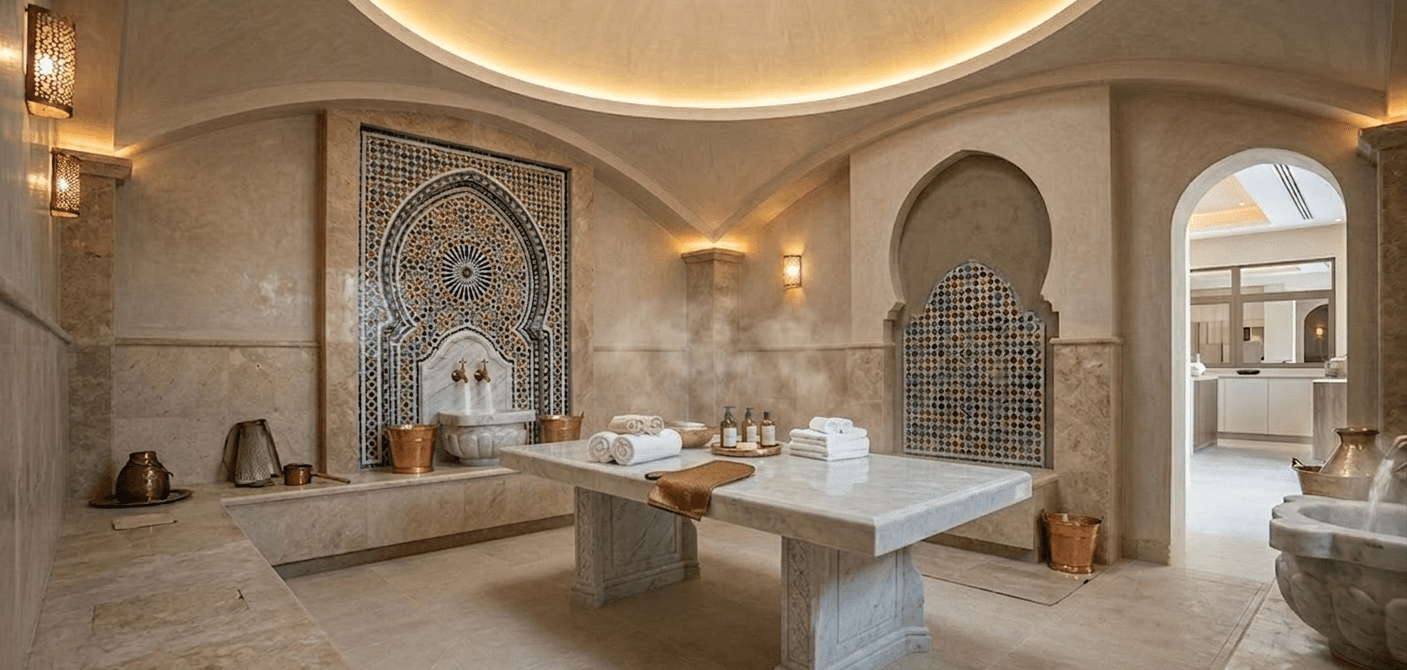
The materials you choose for a Moroccan hammam installation in the UAE determine everything — how the finished space looks, how long it lasts, how much it costs to maintain and whether it performs correctly in the UAE’s uniquely demanding combination of hard water, extreme heat, air conditioning humidity cycling and continuous steam exposure. Getting the material specification right before a single tile is laid or a litre of waterproofing is poured is the single most important factor in the success of any UAE hammam project.
The challenge is that Moroccan hammam materials have been developed and refined over centuries for Moroccan conditions: soft water, moderate seasonal temperatures and traditional heating methods that produce slow, even heat. The UAE’s environment is fundamentally different — and the adaptation of these traditional materials to local conditions requires specific knowledge that many contractors and even specialist suppliers in Dubai do not reliably possess.
This guide covers every material layer of a UAE Moroccan hammam installation — from the subfloor up through waterproofing, adhesive, tile, finish, grout and sealant. For professional Moroccan hammam installation and materials supply in the UAE where every layer is specified correctly for Dubai conditions, our team is available across the Emirates.
What Makes UAE Hammam Material Specification Different
- Hard water: UAE TDS 400–600+ ppm — mineral deposits attack grout, tile surfaces and adhesive bonds at 3–4× the rate of Moroccan or European equivalents
- Thermal cycling: daily hammam use followed by UAE air conditioning creates 25–30°C temperature swings that require flexibility across every material layer
- Subfloor moisture: UAE ground-floor and high-rise buildings often have subfloor moisture conditions that require a dedicated moisture barrier not needed in traditional Moroccan construction
- Sourcing: authentic Moroccan hammam materials must typically be imported — lead times of 4–8 weeks affect project planning; locally available substitutes vary significantly in quality
Adhesive performance: standard adhesives specified for European temperatures lose bonding strength in UAE summer conditions — high-temperature rated products must be used throughout
What Makes UAE Hammam Material Specification Different
- Hard water: UAE TDS 400–600+ ppm — mineral deposits attack grout, tile surfaces and adhesive bonds at 3–4× the rate of Moroccan or European equivalents
- Thermal cycling: daily hammam use followed by UAE air conditioning creates 25–30°C temperature swings that require flexibility across every material layer
- Subfloor moisture: UAE ground-floor and high-rise buildings often have subfloor moisture conditions that require a dedicated moisture barrier not needed in traditional Moroccan construction
- Sourcing: authentic Moroccan hammam materials must typically be imported — lead times of 4–8 weeks affect project planning; locally available substitutes vary significantly in quality
Adhesive performance: standard adhesives specified for European temperatures lose bonding strength in UAE summer conditions — high-temperature rated products must be used throughout
|
Waterproofing Membrane System What it is: The most critical structural layer in any UAE hammam installation — the material that prevents water from migrating through the floor and walls to adjacent spaces and structural elements. Why it matters in UAE: In UAE high-rise properties, hammam water ingress to the slab below is a significant liability risk. Waterproofing failure is the root cause of the majority of hammam renovation projects within 5 years of initial installation. • Two-component cementitious waterproofing (e.g. Mapelastic, Laticrete Hydro Ban): brush-applied slurry system that bonds directly to concrete and creates a flexible, crack-bridging waterproof layer — correct specification for most UAE hammam walls and floors • Sheet membrane systems (e.g. Schluter Kerdi, Wedi board): foam-core sheet membrane bonded to the substrate before tiling — excellent for UAE hammam walls where flexibility and ease of inspection are priorities • Epoxy injection: required at all cracks and weak points in the substrate before membrane application — bridges any existing cracks to prevent reflective cracking through the waterproofing layer • Apply to all surfaces: floors, walls to ceiling height, door threshold, around all pipe and nozzle penetrations — any unsealed penetration creates a water pathway regardless of membrane quality elsewhere • UAE requirement: extend waterproofing to minimum 200mm above the highest water level on all walls — in steam hammams, take to full ceiling height on all surfaces |
Tile Adhesive — High-Temperature Polymer-Modified
What it is: The bonding layer between the waterproofing membrane and all tile surfaces — zellige, bejmat, plain ceramic and natural stone each have different adhesive requirements.
Why it matters in UAE: Standard adhesives specified for bathroom or kitchen applications lose significant bond strength above 40°C in UAE summer conditions. High-temperature polymer-modified adhesive is the only correct specification for UAE hammam tile bonding.
- Specification: C2TE grade polymer-modified tile adhesive (EN 12004 classification) — C2 indicates enhanced adhesion, T indicates thixotropic consistency that prevents zellige from slipping during installation, E indicates extended open time for careful positioning of handmade tiles
- Zellige requirement: double-butter application — apply adhesive to both the wall/floor surface and the back of each tile individually — zellige’s irregular back surface requires this technique to achieve the 90%+ coverage essential for UAE thermal cycling performance
- Bejmat floor requirement: deep-bed adhesive system rated for heavy traffic and point load — bejmat’s 2.5cm thickness and weight requires a specifically rated adhesive bed with adequate depth to embed the tile correctly
Heat resistance: confirm the adhesive product is rated for continuous use at 70°C+ — many standard adhesives are rated to 60°C, which is insufficient for UAE summer hammam conditions where wall surface temperatures at the heater can approach 65°C
Zellige Tiles — Walls, Feature Surfaces and Ceilings
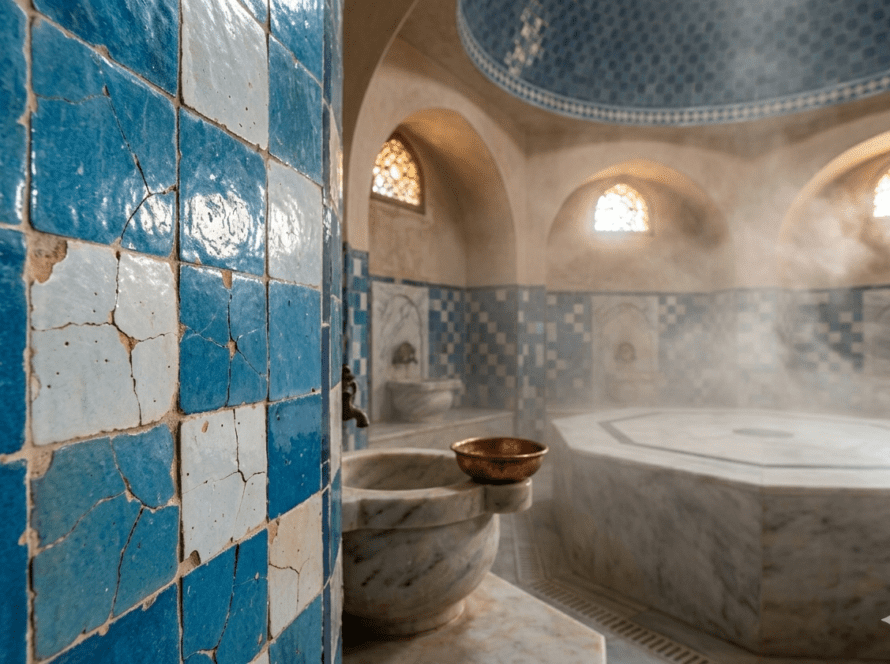
What it is: The defining visual material of an authentic Moroccan hammam — hand-cut, individually fired glazed terracotta tiles produced in Morocco’s Fes and Safi regions.
Why it matters in UAE: UAE hard water deposits minerals on zellige glaze faster than in Morocco — material specification, sealing and cleaning product selection all affect the long-term appearance of zellige in a UAE installation.
- Authentic vs machine-made: authentic hand-fired zellige from Morocco is the only correct specification for an authentic hammam — machine-made ceramic imitations lack the colour depth, light interaction and thermal mass properties of genuine zellige
- Grade selection: specify Grade A or commercial-grade zellige for any installation; Grade B (irregular sizing with colour inconsistency) is appropriate for rustic aesthetic effects but requires more skill to install well
- UAE hard water protection: all zellige must be sealed with a penetrating impregnating sealant before first use and annually thereafter — unseal zellige in UAE conditions develops mineral haze within weeks of use
- Never use acid descalers: acid-based cleaners permanently etch zellige glaze — specify only pH-neutral cleaners in all maintenance documentation and brief all cleaning staff before handover
Lead time: authentic zellige from Morocco requires 4–8 weeks for import — include batch colour matching and sufficient quantity for cuts and future replacement in the initial order
Lorem ipsum dolor sit amet, consectetur adipiscing elit. Ut elit tellus, luctus nec ullamcorper mattis, pulvinar dapibus leo.
Bejmat — Floor Tiles
What it is: The traditional Moroccan hand-fired terracotta rectangular floor tile — 22×11×2.5cm in standard format — used for hammam floors, transitional spaces and occasionally lower wall sections.
Why it matters in UAE: Bejmat’s natural porosity requires specific sealing protocols in UAE hard water conditions — unsealed bejmat in a UAE hammam develops deep mineral staining within 2–3 months that cannot be removed without professional restoration.
- Sealing before first use: apply two coats of penetrating terracotta and natural stone sealant before the hammam is used — this is mandatory in UAE conditions, not optional as in Morocco’s softer water environment
- Underfloor heating compatibility: bejmat is inherently compatible with underfloor heating and performs exceptionally as a heat store — confirm the heating system is rated for the thermal mass load of 2.5cm terracotta before specifying
- Anti-slip confirmation: bejmat’s natural unglazed surface provides significantly better wet slip resistance than glazed tile — confirm anti-slip rating meets UAE property standards for wet room flooring applications
Do not use epoxy grout with bejmat: epoxy grout’s impermeability prevents the moisture-buffering behaviour that makes bejmat perform correctly in a hammam — use flexible anti-mould C2 cementitious grout only
|
|
Tadelakt — Wall and Ceiling Plaster Finish What it is: The traditional Moroccan polished lime plaster used on hammam walls, arched ceilings and carved features — the material that gives an authentic hammam its characteristic warm glow and seamless curved surfaces. Why it matters in UAE: Tadelakt’s waterproofing properties come from its lime carbonation process and the polishing technique — in UAE hard water conditions, the savon beldi treatment that maintains tadelakt’s waterproofing must be applied more frequently than in Morocco. • Authentic vs synthetic: authentic tadelakt is natural hydraulic lime mixed with colour pigments from iron oxides — synthetic microcement alternatives are easier to apply but do not have the same thermal properties, carbon carbonation waterproofing or visual depth • Application requirement: tadelakt application is a traditional craft skill — the waterproofing and visual quality of the finish depends entirely on the plasterer’s technique; this is not a task for a general plastering contractor • UAE maintenance protocol: apply savon beldi (Moroccan black soap) and polish every 6 months in UAE conditions — more frequently than the annual application typically recommended for Moroccan conditions; hard water minerals degrade the tadelakt surface faster • Repair compatibility: tadelakt cracks can be repaired with matching lime paste without stripping the wall — keep a small quantity of matching pigment from the original installation for future repair use |
|
|
Grout, Sealant and Movement Joints What it is: The final jointing and sealing layer — the material that binds the tile system together, resists water ingress through joints and accommodates thermal movement. Why it matters in UAE: Grout failure is the most common cause of UAE hammam maintenance problems within 12–24 months of installation — the specification must be flexible, anti-mould rated and appropriate for the tile type. • Wall and feature grout: flexible anti-mould C2 cementitious grout or epoxy grout for zellige walls — never standard cementitious grout; minimum C2 classification required for UAE thermal cycling tolerance • Floor grout: flexible anti-mould C2 cementitious grout for bejmat floors — epoxy grout is not recommended for bejmat as it prevents the tile’s natural moisture-buffering behaviour • Movement joints: anti-mould silicone sealant at all internal corners and perimeter junctions — grout cracks in corners within one thermal cycle; silicone is mandatory, not optional • Sealant over all grout: apply penetrating impregnating sealant over all grout and tile surfaces after full cure — re-apply every 6 months in UAE hard water conditions |
Complete UAE Hammam Materials Summary
Use this reference table when planning or reviewing a Moroccan hammam installation specification for a UAE property.
|
ZONE |
MATERIAL |
UAE RATING |
KEY SPECIFICATION |
|
Subfloor preparation |
Self-levelling compound + epoxy DPM if RH >75% |
Excellent |
Polymer-modified, wet-room rated; max 3mm lippage tolerance |
|
Waterproofing |
Two-component cementitious membrane or sheet membrane |
Excellent |
Full coverage to ceiling height; all penetrations sealed |
|
Tile adhesive |
C2TE polymer-modified high-temperature adhesive |
Excellent |
Rated 70°C+; double-butter on zellige; deep-bed on bejmat |
|
Zellige wall tiles |
Authentic hand-fired Moroccan zellige Grade A |
Good |
Import 4–8 weeks; seal before use; pH-neutral cleaners only |
|
Bejmat floor tiles |
Authentic hand-fired Moroccan bejmat |
Good |
Seal ×2 before use; re-seal annually; RO water for hammam |
|
Tadelakt wall finish |
Natural hydraulic lime + iron oxide pigments |
Good |
Specialist plasterer only; savon beldi treatment every 6 months |
|
Grout — zellige |
Flexible anti-mould C2 or epoxy |
Excellent |
Seal after cure; re-seal every 6 months |
|
Grout — bejmat |
Flexible anti-mould C2 cementitious only |
Good |
No epoxy on bejmat; seal after cure |
|
Corner joints |
Anti-mould silicone sealant |
Excellent |
Replace every 2–3 years; never fill corners with grout |
Complete UAE Hammam Materials Summary
Use this reference table when planning or reviewing a Moroccan hammam installation specification for a UAE property.
|
ZONE |
MATERIAL |
UAE RATING |
KEY SPECIFICATION |
|
Subfloor preparation |
Self-levelling compound + epoxy DPM if RH >75% |
Excellent |
Polymer-modified, wet-room rated; max 3mm lippage tolerance |
|
Waterproofing |
Two-component cementitious membrane or sheet membrane |
Excellent |
Full coverage to ceiling height; all penetrations sealed |
|
Tile adhesive |
C2TE polymer-modified high-temperature adhesive |
Excellent |
Rated 70°C+; double-butter on zellige; deep-bed on bejmat |
|
Zellige wall tiles |
Authentic hand-fired Moroccan zellige Grade A |
Good |
Import 4–8 weeks; seal before use; pH-neutral cleaners only |
|
Bejmat floor tiles |
Authentic hand-fired Moroccan bejmat |
Good |
Seal ×2 before use; re-seal annually; RO water for hammam |
|
Tadelakt wall finish |
Natural hydraulic lime + iron oxide pigments |
Good |
Specialist plasterer only; savon beldi treatment every 6 months |
|
Grout — zellige |
Flexible anti-mould C2 or epoxy |
Excellent |
Seal after cure; re-seal every 6 months |
|
Grout — bejmat |
Flexible anti-mould C2 cementitious only |
Good |
No epoxy on bejmat; seal after cure |
|
Corner joints |
Anti-mould silicone sealant |
Excellent |
Replace every 2–3 years; never fill corners with grout |
|
💡 Total Budget Context for UAE Moroccan Hammam Installation • Total installed cost for a complete authentic Moroccan hammam in a UAE property (12–18 sqm, all materials and specialist labour) typically ranges from AED 55,000–150,000+ depending on specification level, tile complexity and heating system • Material cost is typically 30–40% of the total installed cost — specialist labour for zellige installation, tadelakt application and waterproofing accounts for the majority of project cost • Saving on material specification — using machine-made zellige replicas, standard adhesive or non-flexible grout — typically costs 2–3× the saving in remediation within 3–5 years |
Materials to Avoid in a UAE Moroccan Hammam Installation
Knowing what not to use is as important as knowing what to specify. The following materials are commonly proposed or used in UAE hammam projects and consistently perform poorly in local conditions.
|
⚠️ These Materials Fail in UAE Hammam Conditions • Standard cementitious grout: no flexibility, porous, mould-prone — fails within 3–6 months in UAE steam conditions; never acceptable in any hammam zone • Standard bathroom tile adhesive: rated to 60°C — loses bond strength in UAE summer conditions; C2TE minimum specification required for all hammam surfaces • Machine-made ceramic zellige replicas: uniform surface, no colour depth, no thermal mass — they look like tiles, not zellige; the physical and visual performance difference is immediately apparent in use • Standard acrylic waterproofing paint: not a hammam-grade waterproofing system — degrades under continuous steam and thermal cycling within 18 months in UAE conditions • Vinegar or acid-based cleaners on any hammam surface: permanently damages zellige glaze, tadelakt, bejmat and grout; must be excluded from any cleaning product specification at the installation stage • Epoxy grout on bejmat floors: prevents natural moisture buffering of terracotta — traps subfloor moisture and causes adhesive failure; use flexible C2 cementitious grout only on bejmat |
Conclusion — Specify Right From the Start
A Moroccan hammam installation in the UAE is a seven-layer material system, and each layer must be correctly specified for the UAE’s specific conditions before a single material is procured. The foundation — subfloor preparation and waterproofing — must be done at the level the space demands. The adhesive must be rated for UAE summer temperatures. The zellige and bejmat must be authentic, sealed correctly and cleaned with pH-neutral products only. The tadelakt must be applied by a trained specialist. The grout must be flexible, anti-mould rated and sealed. The corners must be silicone, never grout.
Every compromise made at the material specification stage — every substitution of authentic with imitation, rated with standard, specialist with general — adds proportionally to the maintenance burden and shortens the installation’s effective lifespan in UAE conditions. The materials that make a Moroccan hammam beautiful, functional and durable in Dubai are well understood. The knowledge to specify them correctly is the single most valuable input any UAE hammam project can receive before the first shovel breaks ground.
For a complete material specification, supply and installation programme managed by experienced specialists, our expert hammam construction and renovation team in Dubai can support projects from initial specification through to handover and ongoing maintenance across Dubai, Abu Dhabi and the UAE.