The Moroccan hammam experience is a traditional multi-step cleansing ritual involving: steam to open pores → black olive soap (beldi) → full-body kessa exfoliation → rhassoul clay mineral mask → warm rose water rinse → argan oil moisturising. Sessions last 45–120 minutes and leave skin visibly softer, brighter, and deeply hydrated. It is both a physical treatment and a centuries-old cultural ceremony deeply embedded in Moroccan life.
You’ve booked your trip to Morocco. Or perhaps you spotted a Moroccan hammam spa in your city and you’re finally curious enough to try it. Either way, you want to know exactly what the Moroccan hammam experience involves before you walk through that arched doorway.
The honest answer? It is simultaneously more intimate, more intense, and more profoundly relaxing than almost anything you’ve experienced in a spa. It is also one of the most skin-transforming rituals on the planet — practised by Moroccan families for over a thousand years.
This guide covers every single detail of the authentic Moroccan hammam experience: what happens, in what order, with which products, at what cost — and what no one tells you before your first visit.
What Is the Moroccan Hammam Experience?
The word hammam derives from Arabic, meaning “spreader of warmth.” The Moroccan hammam experience — also known as a hammam Maghrebi or Hamam Maghrab — is a traditional communal bathing ritual that blends physical cleansing, skin exfoliation, and communal wellness into a single, immersive ceremony.
Unlike a Western spa treatment, the Moroccan hammam experience is not simply a luxury. In Morocco, it is a fundamental part of daily culture — families visit their local hammam weekly, newlyweds are taken before their wedding night, and mothers bring their children as part of life’s rhythm.
The Moroccan hammam experience doesn’t just cleanse your skin — it strips away the accumulated weight of the week, leaving you softer in body and quieter in mind.
What makes the Moroccan hammam experience unique globally is its reliance on specific traditional products — particularly savon beldi (black olive soap), the kessa exfoliation glove, ghassoul (rhassoul clay), and argan oil. Together, these ingredients deliver results that modern skincare formulations have struggled to replicate.
History & Cultural Significance
The Moroccan hammam experience traces its roots to the Roman thermae — public baths built across the Roman Empire over 2,000 years ago. When Islam spread across North Africa in the 7th century, these bathing traditions were absorbed and transformed into spaces of ritual purification (ghusl) before prayer.
The first Moroccan hammam ruins, dating to the late 8th century, were discovered in Volubilis. By the medieval period, hammams were established in every Moroccan city — built beside mosques, schools, and markets as essential civic institutions.
Today, the traditional Moroccan hammam experience remains a living tradition, with public hammams operating in every Moroccan neighbourhood alongside modern spa versions catering to international visitors.
How to Prepare Before You Go
Preparation significantly enhances your Moroccan hammam experience. Here is exactly what to do:
- Hydrate well— drink 2–3 glasses of water before your hammam experience. You will sweat in the steam room.
- Don’t shave 24 hours beforehand— the kessa glove on freshly shaved skin can cause irritation. 24–48 hours is ideal.
- Avoid heavy creams or oilson your skin the day of — you want clean skin ready for maximum exfoliation.
- Don’t eat a large mealwithin 1 hour before — steam and a full stomach is uncomfortable.
- Book in advancefor private or luxury hammams — especially in Marrakech, Fes, and tourist-heavy cities.
- Inform the attendantof any skin sensitivities, allergies, or medical conditions beforehand.
- Arrive relaxed & unhurried— the hammam experience is not something to rush. Allow 30 extra minutes.
What to Wear at a Moroccan Hammam
This is the most Googled question about the Moroccan hammam experience — and the most poorly answered. Here is the definitive guide:
Traditional Public Hammam
Women: bare in all-female rooms, or swimsuit bottom. Men: underwear or shorts in all-male spaces. Paper disposable underwear available on request at most venues.
Private Spa Hammam
Swimsuit bottoms or a bikini bottom. Never a one-piece swimsuit — it prevents proper exfoliation. Disposable briefs are provided at most spas.
Couples Hammam Experience
Same as private spa. Swimsuit bottoms recommended. You’ll be on adjacent marble slabs. Modesty is always respected by professional attendants.
Home Hammam Experience
Whatever you’re comfortable in — or nothing. Your bathroom, your rules. Ensure you’re in a warm shower or bath to simulate the steam room step.
What to Bring
- Dry change of underwear— essential for after the hammam experience
- Flip-flops or rubber sandals— for the changing room and wet floors
- Large absorbent towel— unless the spa includes one in your package
- Your own kessa glove— optional but more hygienic; available at Moroccan markets for $2–5
- Small waterproof pouch— for your phone, cash, and key
- Hair tie— if you have long hair, the clay mask will be applied to your scalp
- Cash (local currency)— many traditional hammams in Morocco do not accept cards
- A completely open mind— the best thing you can bring to your first Moroccan hammam experience
The 8 Steps of the Moroccan Hammam Experience
Here is exactly what happens during an authentic Moroccan hammam experience — every step, in sequence:
Arrival, Changing Room & Preparation
You are welcomed and escorted to a changing room. You change into minimal clothing — swimsuit bottoms or provided disposable underwear — and store your belongings in a secure locker. The attendant gives you rubber slippers and a soft cotton fouta (traditional wrap). At a quality spa, they will walk you through the hammam experience steps so you know exactly what to expect.
The Steam Room — Opening the Pores
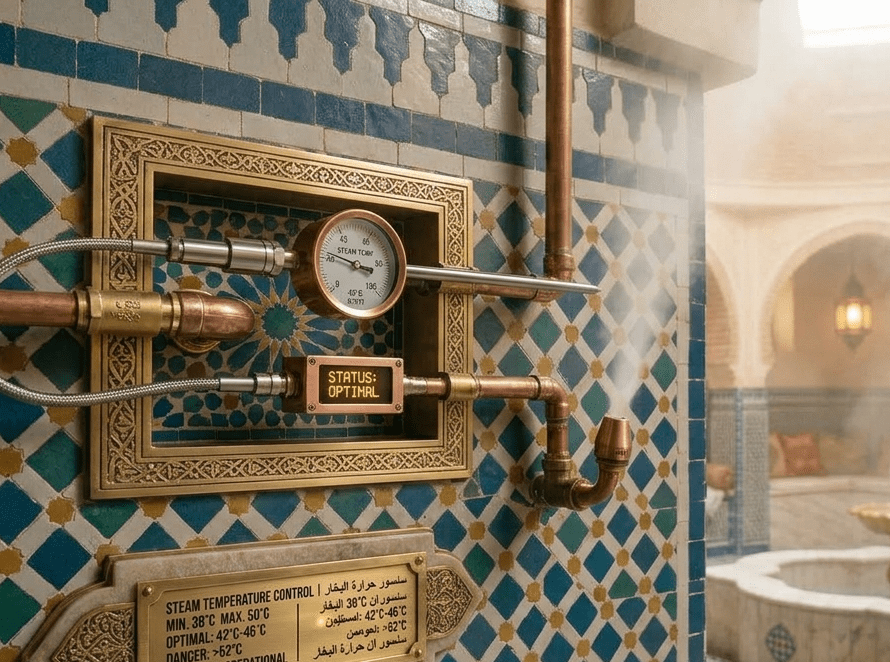
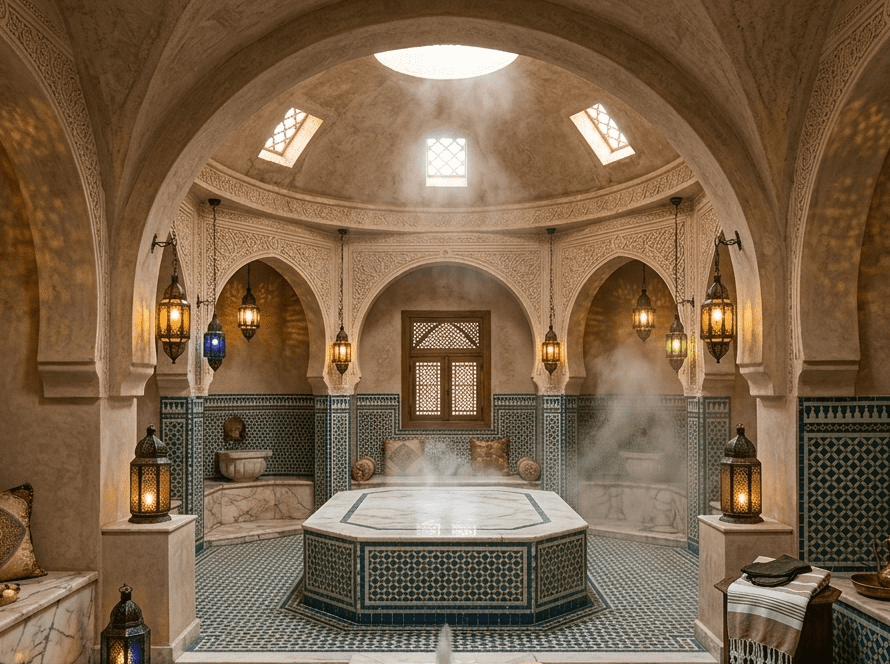
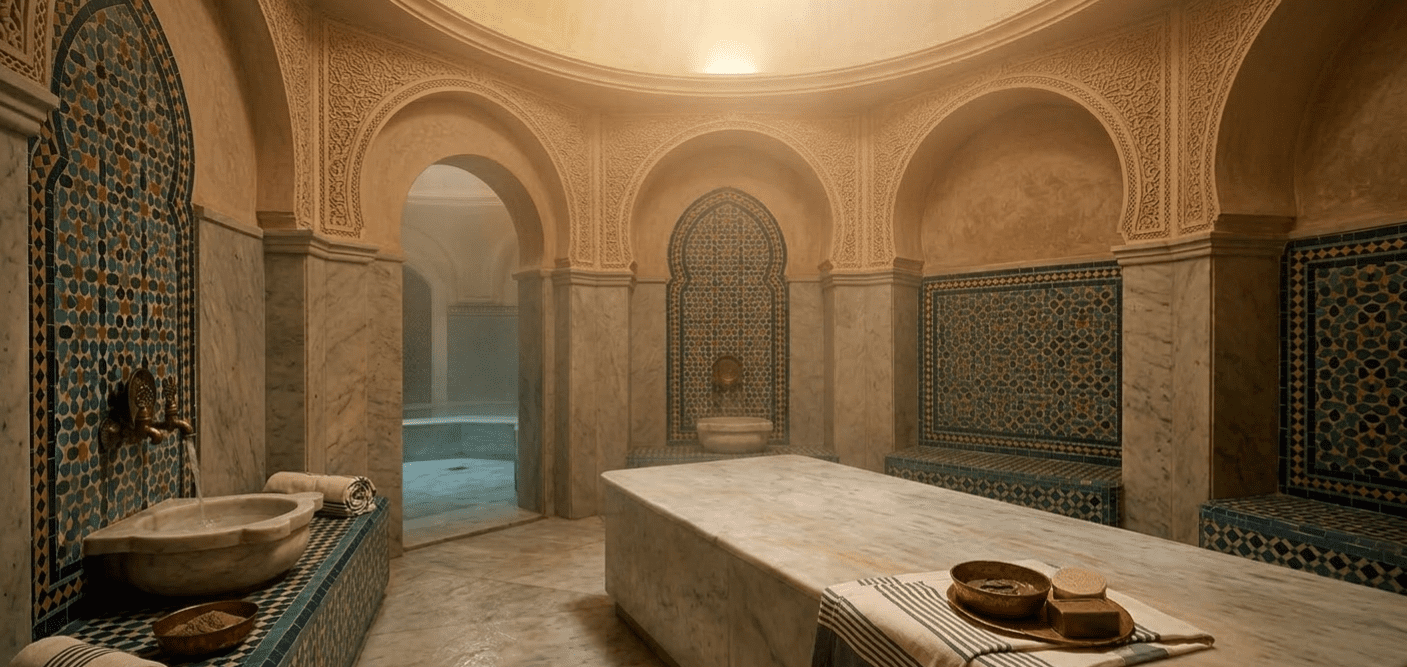
The Moroccan hammam experience begins in a warm, steam-filled room heated between 38°C–50°C (100–122°F). You lie or sit on a heated marble slab — called a kurna in Arabic tradition. The steam saturates the air, loosening dead skin, opening pores, relaxing muscles, and creating the ideal surface for everything that follows. Close your eyes. Breathe slowly. Begin to arrive.
Moroccan Black Soap Application — Beldi Soap
The attendant applies Moroccan black soap (savon beldi) — a thick, glossy paste made from crushed olive pulp, olive oil, and black olives. Rich in Vitamin E and antioxidants, this is the ancient secret at the heart of the Moroccan hammam experience. The soap is massaged into the skin in long, warming strokes and left to penetrate for 5–10 minutes. It softens and lifts dead skin cells, allowing the kessa scrub to work at a completely different level of effectiveness.
Kessa Exfoliation — The Defining Moment
This is the step that defines the entire Moroccan hammam experience — and the one that surprises first-timers most profoundly. Using a kessa glove (a coarse, woven viscose mitt), the attendant scrubs your entire body in long, firm strokes: arms, legs, back, stomach, neck. You will see visibly see rolls of grey, dead skin lifting away from the surface of your body. It is viscerally satisfying. The experience is intense, rhythmic, and oddly meditative. Most people describe it as feeling like having a new body revealed beneath their old skin.
Warm Water Rinse
After the kessa exfoliation, the attendant pours warm water — often infused with rose water — over your entire body to rinse away the black soap, dead skin, and any loosened impurities. The sensation is deeply cleansing and cooling. Your skin at this point will already feel dramatically different from when you arrived — softer, lighter, and strangely luminous even before the next steps.
Rhassoul Clay Mask — The Mineral Treatment
A rich, earthy rhassoul clay mask (also called ghassoul) — mined exclusively from the Atlas Mountains of Morocco — is applied generously across the body, face, and often the hair. This volcanic clay is extraordinarily mineral-rich, containing silica, magnesium, calcium, and potassium. It tightens pores, absorbs excess sebum, brightens dull skin, improves elasticity, and nourishes the scalp. You rest during the 10–15 minutes it works — this is the meditative heart of the Moroccan hammam experience.
Final Rinse & Argan Oil Finish
The clay is rinsed away thoroughly with warm water. You are wrapped in a warmed, dry towel and guided to the final application: pure Moroccan argan oil — cold-pressed from the kernels of the argan tree, grown exclusively in southwest Morocco. On freshly exfoliated skin with open pores, the argan oil is absorbed almost instantly, delivering extraordinary hydration, a natural sheen, and that unmistakable post-hammam glow that people notice for days. This is the moment the full Moroccan hammam experience reveals its result.
Rest & Moroccan Mint Tea
At most private and luxury hammams, the experience concludes in a relaxation lounge. Wrapped in a warm robe, you are served Moroccan mint tea (atay) — poured from a height into small glasses, fragrant and sweet. This is not filler. The cool-down period allows your body temperature to normalise, your pores to gently close, and the argan oil to fully absorb. Many guests sit in companionable silence for a long time after. No one wants to leave. The option of a body massage as an extension of the Moroccan hammam experience is typically offered here.
- Go on a weekday morning for traditional public hammams — they’re quieter and easier to navigate as a first-timer
- Buy your own kessa glove at a Moroccan souk for $2–4 — take it home and recreate elements of the hammam experience weekly
- The clay mask is also incredible for hair — let your attendant know you want it on your scalp for shine and dandruff relief
- Post-hammam skin is primed for any skincare treatment — book a facial or body wrap immediately after for amplified results
- Don’t moisturise before you go — dry skin responds more dramatically to the kessa exfoliation
- Return for your second Moroccan hammam experience within 2 weeks — many people report even better results on visit two
- For the most authentic experience outside Morocco, look for hammams run by Moroccan-trained staff using imported traditional products
The Moroccan Hammam Experience
Is Waiting for You
Across a thousand years of Moroccan culture, the hammam has endured because it works — for the body, for the mind, and for the spirit. Whether you book your first Moroccan hammam experience in Marrakech, Fes, Dubai, London, or your own city, you will leave a different person.
Softer skin. Quieter mind. And a ritual you’ll return to for the rest of your life.