Moroccan Bath Plumbing Requirements Dubai — Installation Guide 2026
A Moroccan bath — hammam — is one of the most plumbing-intensive spa installations in any Dubai hotel, resort or wellness facility. The combination of sustained hot water supply, steam generation, heated marble slabs, continuous floor drainage and DEWA compliance requirements demands specialist MEP planning before a single pipe is laid. This guide covers every plumbing circuit a hammam installation in Dubai requires in 2026.
Why Moroccan Bath Plumbing Is Uniquely Complex in Dubai
A Moroccan bath — traditionally called a hammam — combines multiple water and heat systems simultaneously: constant hot water for the treatment ritual, steam atmosphere, heated marble slabs, and continuous floor drainage. This creates a plumbing load that exceeds almost any other single-room spa installation and requires specialist MEP planning from the very earliest design stage.
In Dubai, that complexity is compounded by the city’s hard mains water supply (300–500 ppm mineral hardness), the regulatory requirements of DEWA and Dubai Municipality’s spa licensing framework, and the operational demands of a five-star hotel spa running multiple hammam sessions daily. Getting the plumbing specification wrong is not a minor issue — a failed Dubai Municipality pre-opening inspection due to inadequate drainage or absent waterproofing can delay a spa opening by months and require hundreds of thousands of dirhams in remedial works.
Hot Water Supply — Temperature, Flow Rate and Dedicated Calorifier Requirements
The hot water supply is the most critical plumbing element in a Moroccan bath installation. The hammam ritual — prolonged application of hot water to heated marble slabs, ambient steam maintenance, heated water for the attendant’s treatment bowls and kessa rinse — demands a sustained, high-volume supply that a standard hotel domestic hot water system cannot meet without dedicated provision.
Temperature Requirements
Critical for hammam ritual and Legionella complianceTemperature Requirements
Critical for hammam ritual and Legionella complianceLorem ipsum dolor sit amet, consectetur adipiscing elit. Ut elit tellus, luctus nec ullamcorper mattis, pulvinar dapibus leo.
Flow Rate and Calorifier Sizing
Sized for simultaneous multi-station operationSteam Generator Plumbing — Cold Feed, Steam Outlet, Condensate and Pressure Relief
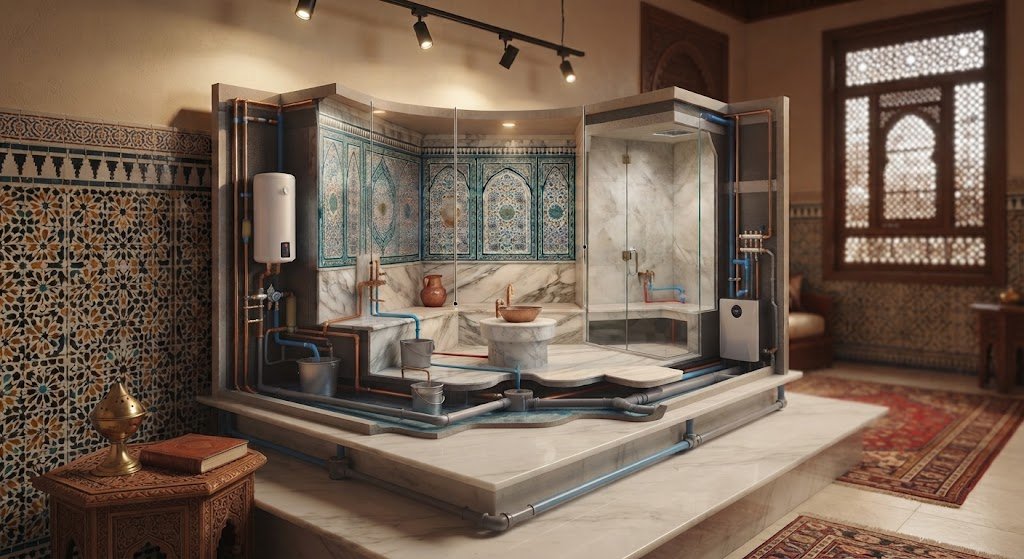
The steam generator delivers the atmospheric heart of the Moroccan bath experience. Its plumbing covers four separate circuits: the cold water feed to the generator, the steam outlet distribution to the room, the pressure relief valve discharge, and the condensate return drainage. In Dubai hotel spas, the steam generator is typically located in a plant room adjacent to the hammam, with steam distributed via insulated pipework to ceiling or low-wall outlets within the treatment room.
- Cold water feed — 15mm copper or CPVC minimum with isolating valve, strainer and non-return valve before the generator inletDEWA-approved materials only; plastic push-fit connections are not permitted on steam generator feeds in Dubai
- Scale inhibitor dosing system — electronic dosing pump injecting inhibitor into the cold water feed line; sized per manufacturer specification for the generator’s steam outputWithout this, steam generator element scale-up occurs within 3–6 months in Dubai’s hard water conditions
- Steam outlet pipework — minimum 28mm copper or stainless steel; fully insulated to prevent condensation and heat loss between generator and room outletsSteam pipework must have a continuous fall back to the generator at 1:100 minimum to allow condensate return
- Steam outlet nozzle positioning — located at 300–500mm above finished floor level to allow steam to rise naturally; positioned away from direct body contact zones and door openingsDubai Municipality spa inspection checks steam outlet positioning as a safety compliance requirement
- Pressure relief valve discharge — PRV must discharge to a visible, accessible location via a copper discharge pipe; not into a concealed voidRequired by DEWA for all pressurised hot water and steam generation equipment in commercial installations
- Condensate drainage — 40mm minimum drain from steam generator to a below-floor trapped drain; condensate temperature can reach 80°C, so cast iron or high-temperature ABS drainage pipe is required — standard uPVC will deformOne of the most common specification errors in Dubai hammam installations: standard uPVC is rated to 60°C maximum
- Automatic blowdown connection — blowdown outlet connects to a trapped floor drain via 25mm copper or stainless pipe; a thermostatic blowdown cooler is required if connected to standard drainageBlowdown water temperature exceeds 80°C; a cooler is a DEWA and DM compliance requirement before discharge
Heated Marble Slab Circuit — The Most Complex Pipework in the Hammam
The heated central marble slab — the hararat — is the defining physical feature of the Moroccan bath ritual. Achieving the correct surface temperature (40–45°C for body contact) requires an embedded hot water circuit beneath and within the marble bed, supplied from the hammam’s dedicated hot water system via a separate thermostatic circuit. This is technically the most complex plumbing element of a hammam installation.
| Component | Specification | Dubai-Specific Requirement |
|---|---|---|
| Embedded pipe material | Cross-linked polyethylene (PEX-A or PEX-B) or copper | PEX rated minimum 70°C continuous; must appear on DEWA’s approved materials list |
| Pipe spacing in slab bed | 150–200mm centres | 150mm spacing for marble over 30mm thickness to achieve uniform surface temperature |
| Circuit flow temperature | 45–55°C supply / 38–45°C return | Thermostatic blending valve mandatory — direct high-temp supply not permitted |
| Manifold location | Accessible service void adjacent to slab | Access panel required; manifold must be serviceable without breaking marble |
| Pressure test | 1.5× working pressure, minimum 1 hour | Written pressure test certificate required for DM inspection sign-off before marble laying |
| Expansion provision | Expansion loops or flexible connections at manifold | Dubai’s thermal cycling between A/C and hammam operation creates significant movement; omission leads to joint failure |
| Isolation valves | Full-bore ball valves at supply and return | Required for maintenance isolation without draining the entire hot water system |
Floor Drainage — Specification for Continuous High-Volume Hot Water Flow
A Moroccan bath generates a continuous and substantial volume of water throughout each treatment session — hot water poured from bowls, rinse water from wall stations, steam condensate from all room surfaces, and attendant washing water. The drainage system must handle this volume continuously without backup, must resist prolonged high-temperature water exposure, and must comply with Dubai Municipality’s drainage requirements for spa and wet facilities.
Floor Drain Specification
Primary drainage for the hammam room
Wall Drainage and Rinse Stations
Kessa stations, bowl fill points and overflow
Waterproofing Specification — Inseparable from the Plumbing Design
Waterproofing is a construction element, but it is inseparable from the plumbing specification in a hammam installation — because every pipe penetration through the waterproofing membrane is a potential leak path. A failed membrane in a Dubai hotel hammam will cause catastrophic structural damage to the floors and walls below and around the room.
- Waterproofing membrane to full wall height — 100% wall and floor coverage; cementitious or liquid-applied system rated for continuous wet exposure applied before tilingLiquid-applied polyurethane membranes from Mapei, Sika or Weber are standard in Dubai hotel spa installations
- Pipe collar gaskets at every penetration — each pipe passing through the floor slab must be sleeved through the membrane with a purpose-made pipe collar gasket sealed into the membrane systemUnsealed pipe penetrations are the single most common source of waterproofing failure in Dubai hammam installations
- Expansion joints at all wall-floor junctions — movement joint filled with flexible sealant compatible with the waterproofing system; re-applied as part of periodic maintenanceDubai’s thermal cycling between A/C and high-temperature hammam operation creates significant substrate movement
- First-fix plumbing complete before waterproofing — all embedded slab circuits, drainage falls and floor drain body installations must be pressure-tested and signed off before the membrane is appliedAny post-waterproofing plumbing modification requiring membrane penetration invalidates the waterproofing warranty
- Flood test before tiling — completed membrane must be flood-tested (50mm water for 24 hours, no measurable drop) before tiling commences; a written flood test certificate is required for DM spa licensingDM spa pre-opening inspection will not pass without this certificate; it cannot be conducted retrospectively after tiling
DEWA-Approved Pipe Materials for Moroccan Bath Plumbing in Dubai
| Application | Approved Materials | Not Permitted | Key Note |
|---|---|---|---|
| Hot water supply | Copper (BS EN 1057) · CPVC (rated 93°C+) | Standard PVC · Plastic push-fit on high-temp circuits | Solder joints must be end-feed; DEWA inspects joint quality |
| Steam outlet pipework | Copper · Stainless steel 316 | Any plastic on steam contact surfaces | Insulation must be continuous; exposed steam pipe is a burn hazard violation |
| Embedded slab circuit | PEX-A or PEX-B (DIN 4726 rated) · Copper | Unrated flexible pipe · Standard MDPE | PEX product must appear on DEWA approved materials list at time of installation |
| Cold water supply | Copper · CPVC · uPVC Class E 10 bar | Galvanised steel · Lead (prohibited UAE-wide) | UAE water regulations prohibit galvanised pipework in potable systems |
| Below-floor drainage | Cast iron · High-temp ABS (100°C rated) | Standard uPVC (max 60°C) for hot condensate drainage | Hammam drainage frequently exceeds 60°C; uPVC failure causes structural risk |
| Above-floor waste pipes | uPVC standard · ABS · Copper | Concealed flexible corrugated pipe in walls | All above-floor waste connections must be accessible for maintenance inspection |
Dubai Municipality Spa Licensing — Plumbing Documentation Required
MEP Design Drawings — Submitted to DEWA Before Installation
Complete MEP drawings — hot water supply schematics, drainage layout, steam generator specification, slab heating circuit details — must be submitted to DEWA by a registered MEP consultant for approval before any first-fix plumbing commences. Works cannot proceed without written DEWA approval.
First-Fix Inspection Before Closing Up
After first-fix plumbing is complete and pressure-tested, a DEWA-registered inspector must sign off the installation before the substrate is closed — waterproofed, tiled or plastered over. The pressure test certificate and inspector’s sign-off must be retained for the DM spa licensing file.
Flood Test Certificate Before Tiling
Once waterproofing is complete, the hammam room must be flood-tested — filled to 50mm above the highest drain invert for 24 hours with no measurable water level drop. A written flood test certificate from the waterproofing contractor is a required document for the DM spa licensing file. This cannot be conducted retrospectively after tiling.
DEWA Plumbing Completion Certificate
On completion of all plumbing works, the DEWA-registered contractor issues a plumbing completion certificate confirming installation in accordance with approved drawings and inspector sign-off. This certificate is a prerequisite for the Dubai Municipality spa facility licence application.
Dubai Municipality Spa Pre-Opening Inspection
DM’s Health and Safety Department inspects all commercial spa and wellness facilities before a spa licence is issued, including steam generator safety, drainage adequacy, water temperature control at body contact points, Legionella risk assessment and emergency shut-off accessibility. All plumbing documentation must be available at inspection — DEWA approvals, pressure test certificates, flood test certificate, completion certificate and water treatment scheme.
Frequently Asked Questions — Moroccan Bath Plumbing Dubai What plumbing is required for a Moroccan bath installation in Dubai?
A Moroccan bath installation in Dubai requires six primary plumbing systems: (1) a dedicated hot water supply at 60–80°C from a dedicated calorifier, with a separate thermostatic circuit serving the heated marble slab at 45–55°C; (2) a steam generator circuit with cold water feed, scale inhibitor dosing, insulated steam outlet pipework, high-temperature-rated condensate drainage, and pressure relief valve discharge; (3) a heated slab circuit with PEX or copper embedded pipework, accessible manifold and thermostatic blending valve; (4) floor drainage in cast iron or high-temperature ABS with stainless steel grade 316 floor drains, rated for continuous hot water flow; (5) cold and blended water supply to all rinse and bowl fill stations via thermostatic mixing valves; and (6) a water softener or scale inhibitor dosing system on all hot and steam feeds — essential for Dubai’s hard water. All pipework must use DEWA-approved materials, be designed by a DEWA-registered MEP consultant, and be signed off by a DEWA-registered contractor as a prerequisite for Dubai Municipality spa licensing.
Yes — this is a non-negotiable legal requirement for any commercial spa installation in Dubai. All plumbing works in commercial premises must be designed by a DEWA-registered MEP consultant and installed by a DEWA-registered plumbing contractor. MEP drawings must receive DEWA approval before installation begins, and on completion a DEWA-registered inspector signs off the installation and issues a completion certificate — which is a prerequisite document for the Dubai Municipality spa facility licence. Using an unregistered contractor risks the installation being condemned and the spa licence being refused, with the full cost of removal and reinstatement falling on the project developer.
A Moroccan bath requires drainage designed for continuous high-volume hot water flow. Floor drains must be stainless steel grade 316 (minimum 100mm body) with a minimum flow capacity of 0.5 litres/second. Below-floor drainage pipework must be cast iron or high-temperature ABS rated to 100°C — standard uPVC is not acceptable as hammam drainage water frequently exceeds 60°C, the maximum rating of standard uPVC. Floor falls must be minimum 1:80 gradient from every floor point to the drain. Each drain must have a deep seal trap of 75mm minimum with anti-siphon provision, cleanable without breaking the floor finish. Dubai Municipality’s pre-opening spa inspection verifies drainage adequacy as part of the spa licensing process
While not a regulatory requirement per se, a water softener or scale inhibitor dosing system is an absolute practical necessity for any Moroccan bath installation in Dubai. Dubai’s mains water has 300–500 ppm mineral hardness, which causes rapid limescale accumulation in hot water circuits, steam generator elements, slab heating circuits and station valves. Without water treatment, scale will degrade steam generator elements within 3–6 months, reduce hot water flow rates, increase energy consumption, and potentially block the embedded slab circuit — a failure that may require partial marble removal to access. The cost of a properly sized water softener (AED 8,000–25,000) is minimal compared to scale-related maintenance and equipment replacement over a 5-year operating period. All experienced MEP consultants designing hammam plumbing in Dubai specify water treatment as a standard element of the scope.