Common Sauna Problems & How Professional Maintenance Helps
The most common sauna problems are a heater that won’t heat or heats slowly, a tripping breaker, crumbling stones, mold and musty smells, stained or warped wood, poor ventilation, and worn door seals. Most are caused by moisture, dust, heat stress and wear. Professional maintenance, usually once a year (every 6 months for heavy use), catches these issues early, keeps the sauna safe, and extends its life.
A sauna works under extreme conditions. It heats to 70–100°C, cools down, and repeats this hundreds of times a year.
Add sweat, steam and dust, and even the best-built sauna will wear over time. The question isn’t whether problems will appear, but whether you catch them early.
This guide explains the 12 most common sauna problems, what causes them, the warning signs, and how professional maintenance prevents each one.
12 common sauna problems at a glance
Use this table to quickly match a symptom to its likely cause. Detailed explanations follow below.
|
# |
Problem |
Likely cause |
How professional maintenance prevents it |
|---|---|---|---|
|
1 |
Sauna not heating or heating slowly |
Failed elements, faulty sensor, wrong sizing, packed stones |
Element and sensor testing, stone restacking |
|
2 |
Breaker keeps tripping |
Damaged element, moisture in wiring, undersized circuit |
Insulation and load testing, wiring checks |
|
3 |
Heater won’t turn on |
Tripped high-limit switch, control fault, power issue |
Control panel and safety-switch diagnostics |
|
4 |
Uneven or fluctuating heat |
Misplaced sensor, poor airflow, bad stone stacking |
Sensor positioning and airflow check |
|
5 |
Cracked or crumbling stones |
Normal heat stress, wrong stone type |
Scheduled stone inspection and replacement |
|
6 |
Mold and mildew |
Trapped moisture, weak ventilation |
Ventilation assessment, moisture checks |
|
7 |
Musty or sour smell |
Absorbed sweat, mold, dirty vents |
Deep clean, sanding, vent cleaning |
|
8 |
Stained, cracked or warped wood |
Sweat, excess water, humidity swings |
Bench sanding, wood treatment, board repair |
|
9 |
Poor ventilation, stuffy air |
Blocked or badly placed vents |
Vent cleaning and airflow balancing |
|
10 |
Heat loss around the door |
Worn seals, misaligned hinges |
Seal replacement, hinge and door adjustment |
|
11 |
Control panel or light failures |
Heat-damaged electronics, loose connections |
Electrical inspection and part replacement |
|
12 |
Leaks and exterior damage (outdoor saunas) |
UV, rain, loose bands, roof wear |
Heater and electrical problems
Heater issues are the most common reason people call a sauna technician. They are also the most important to get right, because they involve high voltage and high heat.
1. Sauna not heating or heating too slowly
Most traditional saunas reach bathing temperature in 30–60 minutes. If yours takes much longer, or never gets hot, something is wrong.
Common causes:
- One or more heating elements have burned out
- The temperature sensor is faulty or placed in the wrong spot
- Stones are packed too tightly, blocking airflow
- The heater is too small for the room’s volume, or the room is poorly insulated
- Glass panels or vents are letting heat escape
How professionals prevent it: A technician tests each element’s resistance, checks the sensor reading against a calibrated thermometer, and restacks or replaces the stones. They can also confirm the heater’s kW rating matches the room size.
2. Breaker keeps tripping
A tripping breaker is a safety warning, not just an inconvenience. Don’t keep resetting it.
Common causes:
- A damaged element leaking current to the heater body
- Moisture getting into wiring or the junction box
- A circuit or breaker that is undersized for the heater
- Loose or corroded connections overheating
How professionals prevent it: Insulation-resistance testing finds failing elements before they trip the breaker. Electricians also tighten terminals and confirm the circuit, cable size and breaker match the heater’s specifications.
3. Heater won’t turn on at all
Common causes:
- The high-limit (overheat) safety switch has tripped
- The control panel, timer or relay has failed
- A blown fuse or power supply problem
- The door safety sensor (on some models) isn’t detecting a closed door
How professionals prevent it: Regular checks of safety switches, contactors and control boards catch wear before total failure. A technician can also explain why a high-limit switch tripped, which often points to blocked airflow or an overheating heater.
4. Uneven or fluctuating temperatures
If the top bench is scorching while the lower bench stays cool, or the temperature swings up and down, the heat isn’t being controlled well.
Common causes: A sensor mounted too close to a vent or the heater, poor air circulation, or badly stacked stones.
How professionals prevent it: Technicians reposition sensors to the manufacturer’s recommended height and distance, and balance intake and exhaust vents for even heat.
5. Cracked or crumbling sauna stones
Stones heat up and cool down with every session. Over time they crack, flake and turn into gravel and dust.
Crumbled stones pack together around the elements. This traps heat, makes the elements overheat, and shortens heater life.
How professionals prevent it: Stones are removed, cleaned and inspected every 6–12 months, and replaced every 1–2 years with regular use. Professionals also make sure you’re using genuine sauna stones, not garden rocks that can split under heat.
Wood, moisture, mold and odor problems
Wood gives a sauna its look, smell and gentle heat. But it is porous, so it absorbs sweat and moisture with every session.
6. Mold and mildew
Mold in a sauna surprises many owners. The room is hot during use, but it can stay warm and damp for hours afterward, which is ideal for mold growth.
Warning signs: Black, green or white spots under benches, in corners, along floorboards or around vents.
Common causes:
- The door is closed straight after use, trapping steam
- Vents are blocked, too small or badly positioned
- Wet towels and mats are left inside
- A damaged vapor barrier lets moisture into the walls
How professionals prevent it: Technicians measure moisture levels, check that the ventilation system actually removes humid air, and treat early mold safely without bleach. If mold keeps returning, they inspect the vapor barrier and wall cavity.
7. Musty, sour or unpleasant smells
A healthy sauna smells of clean, warm wood. A sour or musty smell means something is building up.
Common causes: Sweat soaked into benches, hidden mold, dirty vents, debris under the heater, or old stones holding residue from scented water.
How professionals prevent it: A professional deep clean includes wood-safe cleaning, sanding of sweat-soaked areas, vent cleaning and stone replacement. This removes odors at the source instead of masking them.
8. Stained, cracked or warped wood
Warning signs: Dark sweat stains on benches and backrests, gray patches, splinters, cracks, cupped or lifting boards.
Common causes:
- Sitting directly on the wood without a towel
- Cleaning with too much water or a pressure washer
- Big humidity swings with no drying time
- Varnish or sealant that traps moisture
- The heater installed too close to wooden surfaces
How professionals prevent it: Benches are sanded smooth, treated with sauna-safe bench oil, and loose boards are re-fixed or replaced. Technicians also check that heater clearances meet the manufacturer’s requirements to prevent scorching.
Ventilation, door, controls and outdoor sauna problems
9. Poor ventilation and stuffy air
Good sauna air should feel hot but fresh. Stuffy, heavy air can cause headaches and dizziness, and it shortens comfortable session times.
Common causes: Blocked or dusty vents, vents placed in the wrong position for the heater type, or a missing exhaust vent.
How professionals prevent it: Technicians clean vents and check that fresh air enters near the heater and exits on the opposite side, as most manufacturers recommend.
10. Heat loss around the door
Warning signs: A draft at the door, visible gaps, a door that sticks or swings open, or a sauna that struggles to hold temperature.
Common causes: Worn or compressed seals, loose hinges, or a frame that has shifted as the wood expanded and contracted.
How professionals prevent it: Seals are replaced, hinges tightened and the door realigned so it closes smoothly. A small gap at the bottom is normal for airflow; large side gaps are not.
11. Control panel, light and sensor failures
Electronics in a sauna face constant heat and humidity. Over time, connections loosen and components fail.
Warning signs: Error codes, an unresponsive touch panel, a timer that shuts off early, or a flickering light.
How professionals prevent it: Annual electrical inspections catch corroded terminals, heat-damaged cables, and failing relays. Technicians also confirm the light fitting is rated for sauna temperatures.Common Sauna Problems & How Professional Maintenance Helps
Infrared sauna problems
Infrared saunas have fewer moving parts but their own issues: panels that stop heating, cold spots, flickering carbon or ceramic emitters, and control or Wi-Fi faults.
A professional checks each panel’s output, cable connections and the control system. Panels must be cleaned with a dry cloth only, never water.
Wood-burning sauna stove problems
Wood-fired saunas can suffer from poor draft, smoke entering the room, creosote buildup in the chimney, and cracked stove bodies or door gaskets.
These are serious fire and carbon monoxide risks. A professional chimney sweep and stove inspection at least once a year is essential.
12. Leaks and exterior damage on outdoor saunas
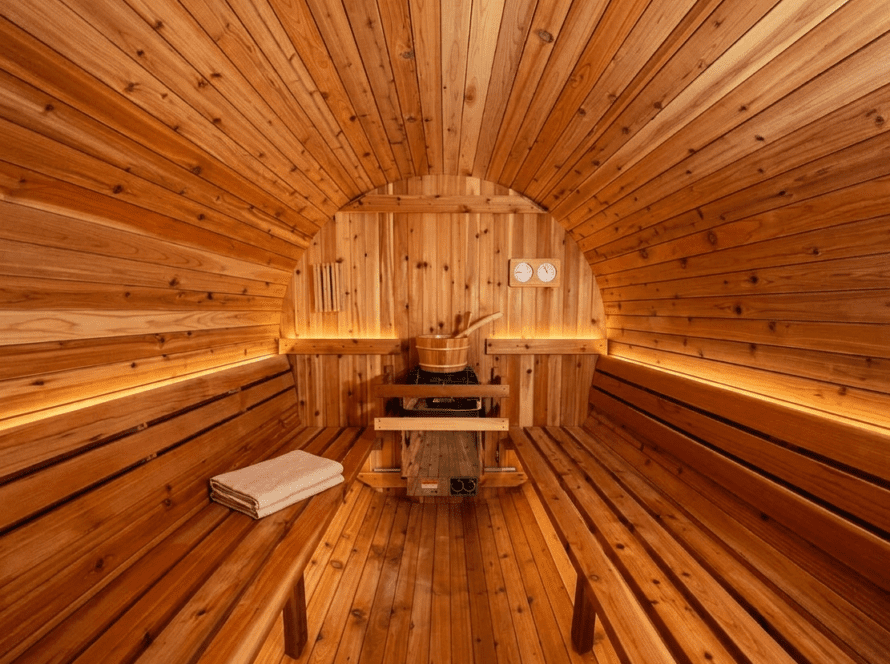
Outdoor and barrel saunas face sun, rain, dust and temperature swings all year.
Warning signs: Water stains on the ceiling, faded or gray exterior wood, gaps between barrel staves, rusted bands, or a sauna that sits unevenly.
How professionals prevent it: Exterior wood is cleaned and re-treated with UV-resistant protection, barrel bands are adjusted, the roof is inspected and resealed, and the foundation is checked for drainage. In hot, dusty or coastal climates, this exterior check matters even more.
What professional sauna maintenance includes
A professional service is more than a cleaning visit. It is a full health check for your sauna’s safety, performance and structure.
A thorough service typically covers:
Heater and electrical
- Element resistance and insulation testing
- Inspection of wiring, terminals, contactors and junction box
- Testing of the thermostat, temperature sensor and high-limit safety switch
- Control panel, timer and lighting checks
- Confirming circuit and breaker sizing
Stones
- Removing, cleaning and inspecting all stones
- Replacing cracked or crumbling stones
- Restacking for proper airflow
Wood and interior
- Deep cleaning with wood-safe products
- Sanding stains and rough spots on benches
- Applying sauna-safe bench oil where suitable
- Repairing or replacing loose, cracked or warped boards
Ventilation and moisture
- Cleaning intake and exhaust vents
- Checking airflow and moisture levels
- Inspecting for mold and treating early growth
Door and structure
- Replacing worn door seals
- Adjusting hinges, handles and door alignment
- Inspecting glass for chips or cracks
Outdoor saunas
- Roof, exterior wood, barrel bands and foundation inspection
- Exterior cleaning and UV treatment
At the end, a good technician gives you a short report: what was checked, what was fixed, and what to watch before the next visit.
How often to book professional sauna maintenance
The right interval depends on how often the sauna is used and what type it is.
|
Sauna type and use |
Recommended professional service |
|---|---|
|
Home sauna, 1–3 sessions a week |
Once a year |
|
Home sauna, 4+ sessions a week |
Every 6 months |
|
Outdoor or barrel sauna |
Once a year, plus an exterior check after harsh seasons |
|
Wood-burning sauna |
At least once a year, including a chimney sweep |
|
Infrared sauna |
Every 1–2 years |
|
Gym, spa, hotel or other commercial sauna |
Every 3–6 months |
Benefits of professional sauna maintenance
Regular professional care pays for itself. Here’s why.
- Safety first. Electrical faults, overheating and chimney blockages are caught before they cause shocks, fires or carbon monoxide exposure.
- Longer lifespan. A well-maintained sauna cabin can last 20 years or more, and heaters often last 10–15 years with good care.
- Lower repair costs. Replacing a worn element or seal is far cheaper than replacing a burned-out heater or rotten benches.
- Better performance. Faster heat-up times, even temperatures and better löyly (steam).
- Lower energy bills. Good seals, clean stones and calibrated sensors mean the heater works less.
- Healthier sessions. Clean wood, fresh air and no mold make every session more hygienic and comfortable.
- Protected warranty. Many manufacturers expect regular maintenance and correct installation for warranty claims.
- Higher property value. A clean, documented, well-kept sauna is a selling point.
The real cost of neglect
Small problems grow quietly. A crumbling stone bed can overheat elements and lead to heater failure. A sticking door seal lets heat escape every session. Hidden moisture can rot benches, walls and floors.
By the time most owners notice, the repair often costs many times more than the maintenance would have. For commercial saunas, there is also downtime, unhappy customers, and potential health-code issues.Common Sauna Problems & How Professional Maintenance Helps
How to choose a sauna maintenance service
Not every handyman understands saunas. Look for a provider who checks these boxes:
- Sauna-specific experience. Ask how many saunas they service and which heater brands they know.
- Licensed electricians for any heater, wiring or control work.
- Experience with your type: traditional, infrared, steam, wood-burning or outdoor.
- Genuine spare parts and proper sauna stones.
- A clear checklist of what each service includes, and a written report afterward.
- Transparent pricing with no surprise call-out charges.
- Maintenance plans for scheduled visits, ideal for busy homes and commercial saunas.
- Good reviews and references from other sauna owners.
The most common causes are burned-out heating elements, a faulty or misplaced temperature sensor, tightly packed or crumbling stones, or a heater too small for the room. A technician can test each one.
Usually a damaged heating element, moisture in the wiring, loose connections, or a circuit that’s too small for the heater. Stop resetting it and call a qualified electrician.
Yes. Saunas stay warm and damp after use, which is ideal for mold. Always ventilate and dry the sauna after every session.Common Sauna Problems & How Professional Maintenance Helps
With good maintenance, sauna heaters typically last 10–15 years. Elements and stones are replaced along the way.
Slow heating, a tripping breaker, uneven heat, a musty smell, visible mold, damaged stones, draughty doors, error codes, or leaks on an outdoor sauna.